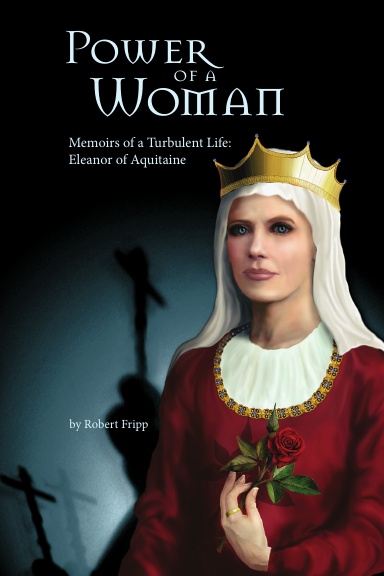
Eleanor of Aquitaine brings her astonishing odyssey to life in POWER OF A WOMAN, her memoir of marriages to two warring kings, Louis VII of France, then England's Henry II. Eleanor recalls wars, intrigues and ruthless diplomacy while confessing her loves, her hopes for her children and their fates -- wresting power from kings and popes while carving space for the feminine in history. Dry wit marks Eleanor's tale of her Court of Ladies and her mystique as the femme fatale of her day. Chicago's Margaret Schmidt calls Robert Fripp "a rare magician, a writer's writer." Read reviews, excerpts and Melissa Snell’s full-length review of this "enjoyable, enlightening book."
"Power of a Woman brings history to life!!" Reading this book aloud to my legally blind companion was immensely fun and educational. We gained many details of Eleanor of Aquitaine's life which I feel other biographers missed, especially her deeply personal feelings around Thomas Beckett. We are brought to ponder Eleanor's emotions in many various contexts. I loved how [the author explains] her relationship with Richard the Lion. And all so vividly expressed from the mouth of a very wise and passionate woman! Through diligent research, and artful pen, Robert Fripp, brings Eleanor of Aquitaine to life. I am absolutely amazed at his stunning ability to know the heart of a woman.
"A Must Read for History Buffs and Non-Buffs" A Must Read for History Buffs and Non-Buffs, August 20, 2007 "Power of a Woman" captures the moment in 1203 when the 80-year old Eleanor of Aquitaine, near the end of her life and feeling mortal, reflects on the life she has lived, and the loves and hurts she has survived. To capture the essence of Eleanor, (queen of first France and then England, mother of Richard the Lionheart and King John of Magna Carta fame), the author has successfully parked his gender beside his name on the title page and written Eleanor's memoirs through the mind of this medieval woman. Jane Rady Lynes, NY
"Eleanor in depth" Robert Fripp's novel/faux memoir has much more multi-layered depth than any of the dozen or more Eleanor books I've read. The characters are richer, the stories and themes have many more angles, and the Eleanor who saw more and aimed higher than the powerful people she played with, really comes through at age 80. It's not the most 'pop' or easy of the books, but it's the richest in its vision, much of it coming from Fripp's journalistic rigour as a former CBC series producer for "The Fifth Estate". He sees very far, in many directions--as did Eleanor.
"A Great Read!!" "Power of a Woman" brings us an "autobiography" of Eleanor of Aquitaine that is accessible and entertaining! Eleanor was Medieval Europe's most interesting woman. In an age when women were considered a necessary evil, and expected to bear sons and be quiet, she defied tradition. She married two of the most powerful men in Europe, and birthed several more. She went on Crusade. She ruled vast territories. She created a definition of love that survives to this day. Telling her story in Eleanor's voice, Robert Fripp shows us Medieval Europe through her eyes: Crusades, wars, enmities, alliances, eternal subterfuge. Fripp's vision brings the very stones and glass of cathedrals and castles to life. History becomes a tapestry which Eleanor works, stitch by stitch. At eighty-one, she hasn't much time. We feel her urgency, the ache in her knees, the chill in her bones. Will she finish before she dies? Her sorrow of lost love, lost children, lost... More > time is as real as the triumphs of her extraordinary life. Eleanor emerges as a woman of great wisdom, dearly won. A real woman, with a strong sense of her place in this life and the next. What a great read! This is so gripping. I got so totally caught up in this story one night that I woke up with images of Eleanor in my mind, and Kate Hepburn's voice in my ear. I love this story."< Less
"Power of a Woman" In “Power of a Woman,” Eleanor of Aquitaine plays a leading role in a world of power-drunk males. Before reading it, I never understood the historic context in which England’s Queen learned to temper her headstrong, impulsive behavior and shape an agenda that changed the power structure of England and Europe. If you don’t read this book out of historic interest, read it out of love of language. I suspect that Robert Fripp is a descendent of one of Eleanor’s own troubadors. His rhythmic crescendos enable us to see, hear, taste, and touch Eleanor’s world. His word pictures dig deep into the psyche, and remain. As a writing teacher, I know that bringing a person to life through the filter of first-person narrative is extremely difficult to do well. But Fripp manages it with exquisite sensitivity to the many layers of Eleanor’s existence, and our own need to understand her. Margaret Schmidt, Newberry Library public seminars lecturer, Chicago