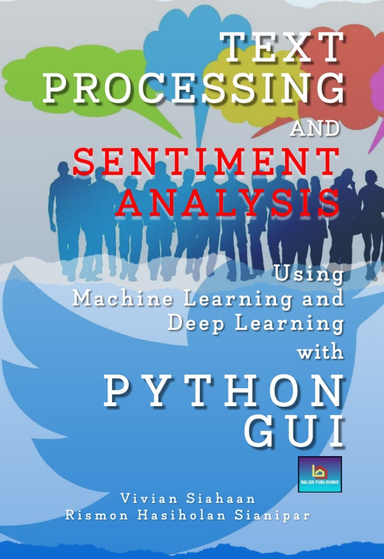
TEXT PROCESSING AND SENTIMENT ANALYSIS USING MACHINE LEARNING AND DEEP LEARNING WITH PYTHON GUI
PorVivian SiahaanRismon Hasiholan Sianipar
Es posible que este libro digital no cumpla las normas de accesibilidad y no sea totalmente compatible con las tecnologías de asistencia.
Twitter data used in this project was scraped from February of 2015 and contributors were asked to first classify positive, negative, and neutral tweets, followed by categorizing negative reasons (such as "late flight" or "rude service"). This data was originally posted by Crowdflower last February and includes tweets about 6 major US airlines. Additionally, Crowdflower had their workers extract the sentiment from the tweet as well as what the passenger was dissapointed about if the tweet was negative.
The information of main attributes for this project are as follows: airline_sentiment : Sentiment classification.(positivie, neutral, and negative); negativereason : Reason selected for the negative opinion; airline : Name of 6 US Airlines('Delta', 'United', 'Southwest', 'US Airways', 'Virgin America', 'American'); and text : Customer's opinion.
The models used in this project are K-Nearest Neighbor, Random Forest, Naive Bayes, Logistic Regression, Decision Tree, Support Vector Machine, Adaboost, LGBM classifier, Gradient Boosting, and XGB classifier, and LSTM. Three vectorizers used in machine learning are Hashing Vectorizer, Count Vectorizer, and TFID Vectorizer.
Finally, you will develop a GUI using PyQt5 to plot cross validation score, predicted values versus true values, confusion matrix, learning curve, performance of the model, scalability of the model, training loss, and training accuracy.
Detalles
- Fecha de publicación
- Mar 30, 2023
- Idioma
- English
- Categoría
- Computadoras y tecnología
- Copyright
- Todos los derechos reservados - Licencia estándar de copyright
- Contribuyentes
- Por (autor o autora): Vivian Siahaan, Por (autor o autora): Rismon Hasiholan Sianipar
Especificaciones
- Formato