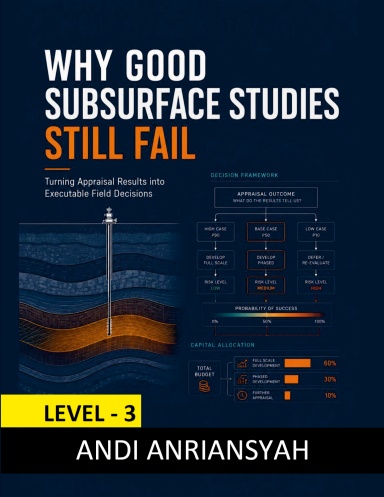
WHY GOOD SUBSURFACE STUDIES STILL FAIL
Turning Appraisal Results into Executable Field Decisions
Usualmente se imprime en 3 - 5 días hábiles
Most subsurface studies do not fail because the geology is wrong.
They fail because technically valid studies are translated into development decisions without defining the operational and economic boundaries that determine whether a project can actually survive reality.
Across the oil and gas industry, asset teams routinely produce sophisticated appraisal work: volumetric estimates, reservoir simulations, probabilistic forecasts, recovery factor ranges, and development concepts built on technically defensible assumptions. Yet projects still suffer from oversized facilities, premature water breakthrough, underperforming plateau rates, escalating operating costs, delayed compression requirements, and capital destruction that was never identified during the study phase.
This book examines the structural gap between subsurface analysis and executable decision-making.
Rather than focusing only on geology or reservoir engineering theory, WHY GOOD SUBSURFACE STUDIES STILL FAIL introduces a practical framework for transforming appraisal studies into decision-ready development architecture. It explains why P10/P50/P90 ranges are frequently misunderstood, how economic thresholds disappear between workflows, why uncertainty often becomes disconnected from facility design, and how organizations unintentionally approve development concepts that were never robust to begin with.
Using realistic field-development scenarios, decision frameworks, uncertainty translation methods, and capital exposure mapping approaches, this book provides a structured methodology for:
• Converting uncertainty into operational boundaries
• Defining economic floors before capital commitment
• Stress-testing development concepts against subsurface variability
• Linking appraisal outcomes to executable decisions
• Identifying hidden sources of capital fragility
• Building decision-ready subsurface workflows for marginal and mature assets
Written for geoscientists, reservoir engineers, asset managers, development planners, technical assurance teams, and upstream decision-makers, this book bridges the gap between technical rigor and capital discipline.
This is not a book about generating better studies.
It is a book about making better decisions from the studies already being produced.
Detalles
- Fecha de publicación
- May 27, 2026
- Idioma
- English
- ISBN
- 9781105628290
- Categoría
- Ingeniería
- Copyright
- Todos los derechos reservados - Licencia estándar de copyright
- Contribuyentes
- Por (autor o autora): Andi Anriansyah
Especificaciones
- Páginas
- 323
- Tipo de encuadernación
- Tapa blanda Tapa blanda
- Color de interior
- Color
- Dimensiones
- Carta EE.UU. (8,5 x 11 in / 216 x 279 mm)
Palabras clave
Subsurface StudiesReservoir EngineeringField Development PlanningAppraisal StrategyUncertainty AnalysisDecision ArchitectureReservoir UncertaintyCapital RiskAsset ManagementMarginal Field DevelopmentUpstream Oil and GasReservoir ManagementDecision-Making in Oil & GasStrategic Reservoir Engineeringoil and gas booksubsurface uncertaintysubsurface governance