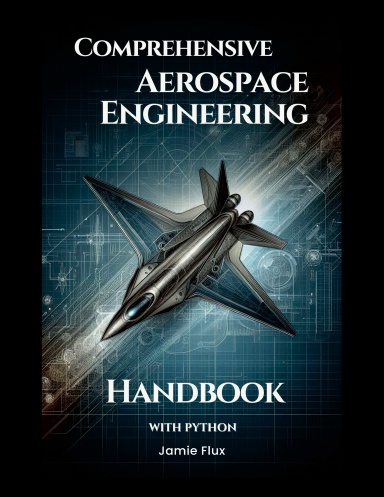
Comprehensive Aerospace Engineering Handbook with Python
PorJamie Flux
Usualmente se imprime en 3 - 5 días hábiles
Unlock the full potential of aerospace engineering with the most comprehensive guide available.
Dive deep into the intricate interplay of physics, engineering, and technology that defines this cutting-edge field. This exhaustive handbook is your key to mastering the mathematical and theoretical foundations necessary for designing state-of-the-art aircraft and spacecraft.
With Python coding examples accompanying each chapter, this resource provides a practical framework that links theoretical concepts to hands-on applications. Suitable for students, professionals, and enthusiasts alike, this book is a definitive guide for anyone looking to excel in the realm of aerospace engineering.
Key Features
- In-depth exploration of foundational and advanced principles in aerospace engineering.
- Practical Python code for every chapter to reinforce learning through application.
- A vast array of topics covering critical components of aerospace design and analysis.
- Insightful explanations of equations, principles, and mechanisms essential for aerospace success.
- Guidance on implementing data analytics and simulations integral to modern aerospace challenges.
What You Will Learn
- Gain a solid understanding of fluid dynamics through the Bernoulli, continuity, and Navier-Stokes equations.
- Analyze various flow patterns using Reynolds number applications to identify laminar and turbulent flows.
- Calculate lift and drag for aircraft design optimization.
- Explore thrust generation principles essential for overcoming aerodynamic drag.
- Apply conservation laws to momentum, energy, and gases with practical aerospace implications.
- Understand the mechanics of shock waves and isentropic flows through Mach numbers and specific heat ratios.
- Delve into advanced aerodynamics with Prandtl’s lifting-line theory and vortex dynamics.
- Implement Euler’s equations to solve inviscid flow problems effectively.
- Master calculations for wing load distributions and aerodynamic lift using methods such as vortex panel analysis.
- Perform structural analysis using finite element methods to assess stresses and displacements.
- Evaluate aerodynamic performance through complex flow simulation using RANS equations.
- Understand the significance of boundary layers and laminar-turbulent transitions in aerospace design.
- Control aerospace environments with modal analysis and eigenvalue evaluations.
- Optimize flight trajectories using advanced trajectory algorithms for efficiency
Detalles
- Fecha de publicación
- Jun 28, 2025
- Idioma
- English
- Categoría
- Ingeniería
- Copyright
- Todos los derechos reservados - Licencia estándar de copyright
- Contribuyentes
- Por (autor o autora): Jamie Flux
Especificaciones
- Páginas
- 407
- Tipo de encuadernación
- Tapa blanda Tapa blanda
- Color de interior
- Blanco y negro
- Dimensiones
- Carta EE.UU. (8,5 x 11 in / 216 x 279 mm)