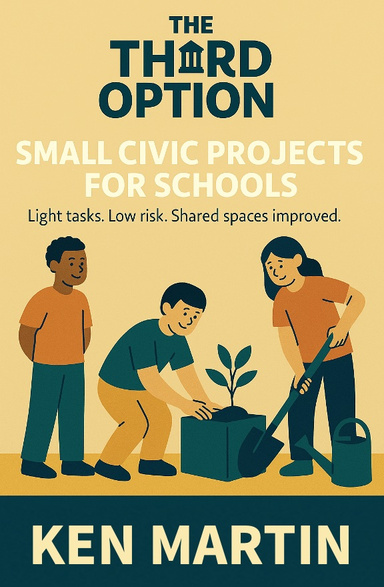
Small Civic Projects for Schools
A Third Option Mini Guide
PorKen Martin
Es posible que este libro digital no cumpla las normas de accesibilidad y no sea totalmente compatible con las tecnologías de asistencia.
Small Civic Projects for Schools
Most school problems start small. A crowded doorway. A cluttered reading corner.
Slow movement through a tight corridor. These small issues create delay, noise, and stress, even though each one has a simple fix.
The new mini guide, Small Civic Projects for Schools, helps students take light, safe actions that improve shared spaces.
- No big program.
- No extra load.
- One space. One issue. One action.
Why this matters
UNESCO and OECD research indicate that small improvements to shared spaces can increase belonging, reduce friction, and foster calmer movement patterns.
Students respond well to routines where purpose is clear and risk stays low.
Tiny changes shift daily experience more than large plans.
How it works
- Students follow one loop.
- See the issue.
- Plan one safe action.
- Do the work.
- Review what changed.
- Share the result.
The loop builds judgment, teamwork, and quiet ownership.
Proof
Schools already use this pattern. Singapore uses floor markers to improve corridor flow. Kenya uses shared tool baskets to speed up group work. Brazil uses bottle return points to keep learning spaces clean. Thailand uses slide-in shoe lines to calm entry. Denmark uses weekly refresh routines to stabilise reading corners.
Each case shows the same pattern: small, low-risk tasks improve flow.
Benefits
- Students gain calm confidence.
- Teachers spend less time resetting rooms.
- Parents see steady responsibility.
- The school benefits from cleaner, easier spaces.
Risk
- Projects grow when the scope is unclear.
-Control: One space, one action, one quick improvement.
Next steps
- Start with one shared space.
- Then a small team.
- Then group work.
- Later, link projects to local community tasks.
The pattern stays simple at every stage. Small civic actions teach students how shared spaces improve. Not through speeches. Through steady contribution.
All information on the Third Option - “Simple Tools for Local Change” is on my Substack- https://lnkd.in/e5R4gZJW. . Everything is free to use, to share and to adapt at your pleasure. More books and tools are being developed.
Detalles
- Fecha de publicación
- Nov 23, 2025
- Idioma
- English
- Categoría
- Educación e idioma
- Copyright
- Todos los derechos reservados - Licencia estándar de copyright
- Contribuyentes
- Por (autor o autora): Ken Martin
Especificaciones
- Formato