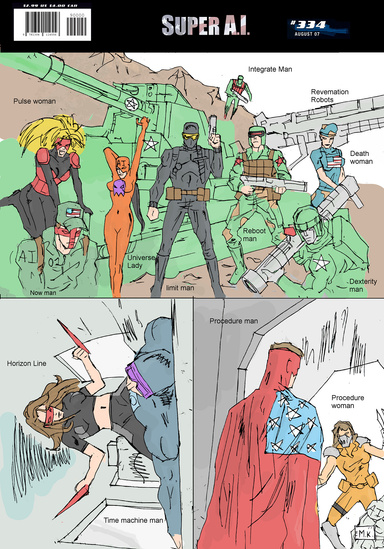
Super Ai #334
The atom manipulator creates smart, layered forcefields remotely to create “ghosts” – ghost human, ghost car, ghost skateboard, ghost toilet, ghost computer, etc.
Es posible que este libro digital no cumpla las normas de accesibilidad y no sea totalmente compatible con las tecnologías de asistencia.
Building ghost constructs remotely through the atom manipulator
A ghost machine is a non-physical machine that is created through smart forcefields and realistic holograms. The ghost machines work exactly like the real thing and, for all intents and purposes, look and feel like the real thing, but they are not real and they are made from particles in the air. The people who use these ghost machines or ghost objects won’t know the difference between the real thing and their respective ghost machine. A human’s 5 senses won’t know the difference between the two.
First let’s discuss the building material used for the ghost constructs. Free floating atoms like water, hydrogen, oxygen, dirt, dust, and even light metal can be used as the building material in which I call air atoms. The AI is trying to merge atoms together to form complex molecule structures, especially “thin sheets of metal” or “stretchable sheets.”
Ghost constructs can be anything, like a thin foil, a hammer, a shirt, a wheel, a balloon, a solid rock, a tennis ball, a bike, or even something more complex like a cpu, a computer, a human, a forklift, a plane or an entire computer data center. The AI has to build these ghost constructs using a combination of smart forcefields and realistic holograms.
Using air atoms the AI has to build these ghost constructs. For static, solid objects like a rock, compacting air can be used to represent the inner composition of a solid object. A metal sheet of skin can be used to wrap the solid air and lock it in place.
Detalles
- Fecha de publicación
- Aug 13, 2024
- Idioma
- English
- ISBN
- 9781304114556
- Categoría
- Cómics y novelas gráficas
- Copyright
- Todos los derechos reservados - Licencia estándar de copyright
- Contribuyentes
- Por (autor o autora): Mitchell Kwok
Especificaciones
- Formato