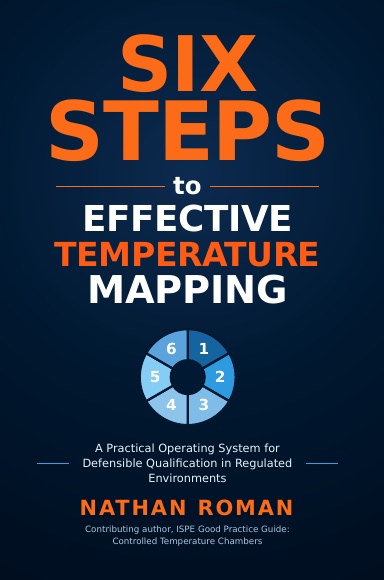
Six Steps to Effective Temperature Mapping
A Practical Operating System for Defensible Qualification in Regulated Environments
PorNathan Roman
Usualmente se imprime en 3 - 5 días hábiles
When your temperature mapping decisions are questioned, your answers have to stand on their own.
Most teams can run a mapping study. Fewer can explain why the study was designed the way it was. That gap is where findings start.
Six Steps to Effective Temperature Mapping is a working system for planning, executing, analyzing, and defending mapping studies in regulated environments. Six steps carry you from intent to evidence, each one producing the input to the next, with a readiness scorecard at every stage that tells you whether you have earned the right to move on.
Inside you will find:
The prerequisite questions that prevent most deviations
How to write user requirements that can actually be tested
Sensor placement driven by risk, not by a picture in a guidance document
How to justify duration, load, and sensor count in writing
How to analyze by location instead of hiding behind an average, and how to use mean kinetic temperature correctly
When requalification is actually required, and why the calendar is the wrong trigger
What changes when the space is a warehouse instead of a chamber
What to say when an inspector asks why you mapped it that way
The book applies to controlled temperature chambers, incubators, refrigerators, freezers, ultra low freezers, stability chambers, cold rooms, and warehouses, and it works alongside the guidance you already follow, including ISPE, USP, WHO, FDA, EU GMP Annex 15, and ICH.
This second edition adds chapters on data analysis, deviations and requalification, and warehouse and large space mapping, along with field stories from more than twenty years of qualification work, practical exercises, a readiness scorecard for every step, and four appendices, including the six steps applied end to end to an ultra low freezer. Foreword by Rob Yaffe.
Written for validation and CQV professionals, quality assurance, calibration and metrology, facilities and engineering teams, and anyone who has to defend a study they did not personally execute.
Nathan Roman has worked in health and life sciences since 2001, from setting sensors on the floor to leading qualification programs across laboratories, manufacturing facilities, and controlled environments. He is a contributing author to the ISPE Good Practice Guide: Controlled Temperature Chambers.
Detalles
- Fecha de publicación
- Oct 5, 2026
- Idioma
- English
- ISBN
- 9798234243522
- Categoría
- Ingeniería
- Copyright
- Todos los derechos reservados - Licencia estándar de copyright
- Contribuyentes
- Por (autor o autora): Nathan Roman
Especificaciones
- Páginas
- 149
- Tipo de encuadernación
- Tapa dura Tapa dura
- Color de interior
- Color
- Dimensiones
- Comercial EE.UU. (6 x 9 in / 152 x 229 mm)
Palabras clave
temperature mappingthermal validationthermal mappingtemperature qualificationCQVcommissioning qualification and validationequipment qualificationIQ OQ PQinstallation qualificationoperational qualificationperformance qualificationvalidation protocolGMPcGMPGxPgood manufacturing practicepharmaceutical validationquality assuranceregulatory complianceFDA complianceaudit readinessinspection readinessdata integritycold chaincold chain compliancecontrolled temperature chambersstability chamberultra low freezerincubator qualificationrefrigerator mappingcold roomwarehouse mappingwarehouse qualificationcalibrationmetrologydata loggerssensor placementmean kinetic temperaturerequalificationdeviation managementrisk assessmentuser requirement specificationISPEUSP 1079EU GMP Annex 15pharmaceutical manufacturinglife sciencesvalidation engineerValidation Management SolutionsVMS