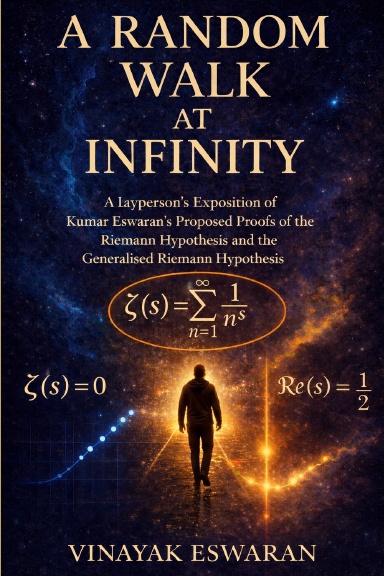
A Random Walk at Infinity
A Layperson's exposition of Kumar Eswaran's proposed proofs of the Riemann Hypothesis and the Generalised Riemann Hypothesis
Usualmente se imprime en 3 - 5 días hábiles
This book presents the problem of the Riemann Hypothesis (and later the Generalised Riemann Hypothesis). It details the relevant developments from the work of Riemann (1859) to Littlewood (1912) and gives the comprehensive proofs proposed by Kumar Eswaran (2016-18) that use the probabilistic Law of the Iterated Logarithm of A.Y.Khinchin and A.N.Kolmogorov from the 1920's. No mathematics discovered after 1930 is used in the proofs.
The book assumes no prior knowledge of the Riemann Hypothesis, or even advanced complex analysis. Starting from first principles, and free of jargon and abstract notation, the book can be read by undergraduate students of any mathematical discipline of science and engineering.
While its tone and language are directed at STEM educated laypersons, the book contains the detailed complete proofs. So mathematicians, scientists and graduate students are invited to read the book and critique the proofs (after reading, at least, Chapters 5 to 12 in their entirety).
The implications of the simultaneous proof of these two problems, considered to be the greatest in Pure Mathematics, are staggering in ways totally unanticipated. Foremost among these is that, contrary to universal expectation, the proofs say nothing at all new about prime numbers. Further, they question the foundational promise and future prospects of Analytic Number theory.
Detalles
- Fecha de publicación
- Jul 18, 2026
- Idioma
- English
- ISBN
- 9789376865604
- Categoría
- Ciencia y medicina
- Copyright
- Todos los derechos reservados - Licencia estándar de copyright
- Contribuyentes
- Por (autor o autora): Vinayak Eswaran
Especificaciones
- Páginas
- 338
- Tipo de encuadernación
- Tapa blanda Tapa blanda
- Color de interior
- Blanco y negro
- Dimensiones
- Comercial EE.UU. (6 x 9 in / 152 x 229 mm)