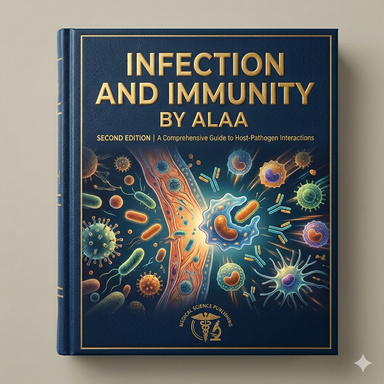
Comprehensive Foundation in Infection & Immunity
Specialist’s Guide to Infection & Immunity
VonAlaa A
Dieses E-Book entspricht möglicherweise nicht den Standards zur Barrierefreiheit und ist eventuell nicht vollständig mit unterstützenden Technologien kompatibel.
The course document "Basic Infection and Immunity" is organized into the following chapters and major sections:
1. Introduction & Overview
2. Pathogens: "The Invaders"
Detailed sections on the four main types of infectious agents:
Bacteria: Characteristics of prokaryotic organisms, reproduction via binary fission, and examples like Tuberculosis. Viruses: Non-independent particles that replicate inside host cells, including examples like Influenza and HIV. Fungi: Covers yeasts and molds, opportunistic infections, and their diverse reproduction methods (budding, spores, and fission).Parasites: Divided into Protozoa (unicellular eukaryotes like Malaria) and Helminths (multicellular parasitic worms like Ascaris).
3. Pathogenesis: How Disease Develops
This section explains the four stages of how microorganisms cause illness:
Entry: How pathogens enter through the skin, respiratory tract, or gastrointestinal tract. Attachment (Adhesion): The use of pili or capsules to anchor to host cells. Multiplication: How bacteria and viruses multiply within or among human cells. Tissue Damage: Direct cell destruction or the release of toxins.
4. Immunology: "The Defense"
Innate Immunity (Natural): The fast, general first line of defense including barriers like skin and stomach acid.
Adaptive Immunity (Acquired): Targeted, memory-based defense divided into
Humoral Immunity: B lymphocytes producing antibodies. Cellular Immunity: T lymphocytes killing infected cells.
Antigens and Antibodies: Definitions and roles of specific proteins in triggering immune responses. Types of Antibodies (Immunoglobulins): Detailed breakdown of IgG, IgM, IgA, IgE, and IgD, and what they indicate about an infection (e.g., IgM for recent infection vs. IgG for past immunity).
5. Laboratory Relevance
Hematology Lab: Using the Complete Blood Count (CBC) and white blood cell differential to find the "first clues" of infection. Microbiology Lab: Identifying pathogens through staining and culture sensitivity Serology Lab: Monitoring antigens and antibodies (e.g., ELISA tests) to track immune responses and vaccine effectiveness
Details
- Veröffentlicht am
- Apr 17, 2026
- Sprache
- English
- Kategorie
- Medizin & Wissenschaft
- Copyright
- Alle Rechte vorbehalten - Standard-Urheberrechtslizenz
- Autoren/Mitwirkende
- Von (Autor): Alaa A
Spezifikationen
- Format