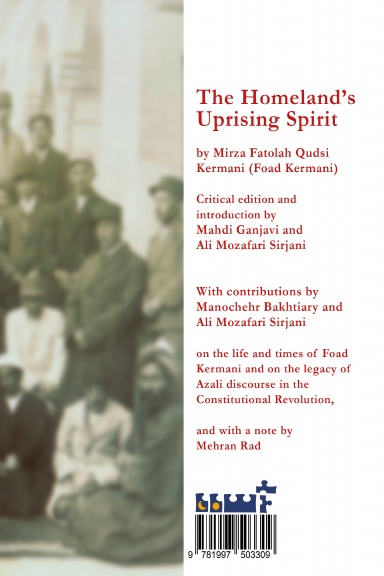
The Homeland’s Uprising Spirit
With contributions on the life and times of Foad Kermani and on the legacy of Azali discourse in the Constitutional Revolution
DiMirza Fatolah Qudsi KermaniMahdi Ganjavi
Di solito viene stampato in 3-5 giorni lavorativi
The Azali movement, which took shape after the death of the Báb and in opposition and competition with the Bahá’í religion, was not merely a religious one. The Azalis sought to produce, from within the Islamic–Iranian tradition, an esoteric, anti-despotic, and reformist reading and discourse—one that on the one hand demanded a reworking of the Islamic tradition, and on the other sought to transform the foundations of religious authority by expanding the textual core and displacing established loci of authority. In this respect, the Azalis occupied an intermediary position, oscillating among three domains: mystical and esoteric tradition, modern rationality, and emancipatory thought.
The Azalis were well aware that openly expressing their beliefs in Qajar Iran would cost them their lives. For this reason, their writings assumed a dual character: an outward, exoteric layer and an inward, esoteric one. On the surface, they offered moral counsel and called for the ethical reform of society. At a deeper level, however, they pursued a critique of religious authority and the dissolution of the clerical institution, a critique of Islamic law and a call for its reconfiguration, as well as an invitation to struggle against the Qajar state.
This duality is clearly manifested in the works of Foād-e Kermānī, especially in Hayajān al-Vaṭan. At first glance, the language of the poetry appears nationalistic and declamatory; yet at a deeper level, it enters into dialogue with the thought and worldview of the Bábí movement and its social and political implications. Consequently, if the text is not read through a symbolic and code-conscious lens—one attentive to Azali allusions and the numerical calculations of words—it may be understood merely as a secular or Shiʿi reformist constitutionalist text, causing its distinct intellectual layers to be overlooked. Such oversight has plagued many readings of Azali beliefs and interpretations of the Iranian Constitutional Revolution.
Foad was a constitutionalist poet from Kerman, and since figures such as Mirza Aqa Khan, Shaykh Ahmad Ruhi, Mirza Reza, Majd al-Islam, and Nazem al-Islam emerged from this city, studying his poetry may be regarded as opening a window onto one of the major centers of the Iranian Constitutional Movement—namely, Kerman.
Dettagli
- Data di pubblicazione
- Mar 30, 2026
- Lingua
- Farsi
- ISBN
- 9781997503309
- Categoria
- Scienze umanistiche
- Copyright
- Tutti i diritti riservati - Licenza di copyright standard
- Collaboratori
- Di (autore): Mirza Fatolah Qudsi Kermani, Modificato da: Mahdi Ganjavi, Modificato da: Ali Mozafari Sirjani, Prefazione di: Mahdi Ganjavi, Commentari di: Ali Mozafari Sirjani, Commentari di: Manochehr Bakhtiary, Commentari di: Mehran Rad
Specifiche
- Pagine
- 350
- Tipo di rilegatura
- Libro a copertina morbida Libro a copertina morbida
- Colore del contenuto
- Bianco e nero
- Dimensioni
- US Trade (152 x 229 mm)