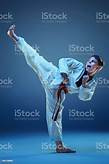
Disciplinary karate sports book
Cet ebook peut ne pas être conforme aux normes d'accessibilité et ne pas être totalement compatible avec les technologies d'assistance.
Karate (空手) (/kəˈrɑːti/; Japanese pronunciation: [kaɾate] (audio speaker iconlisten); Okinawan pronunciation: [kaɽati]) is a martial art developed in the Ryukyu Kingdom. It developed from the indigenous Ryukyuan martial arts (called te (手), "hand"; tii in Okinawan) under the influence of Chinese martial arts, particularly Fujian White Crane.[1][2] Karate is now predominantly a striking art using punching, kicking, knee strikes, elbow strikes and open-hand techniques such as knife-hands, spear-hands and palm-heel strikes. Historically, and in some modern styles, grappling, throws, joint locks, restraints and vital-point strikes are also taught.[3] A karate practitioner is called a karateka (空手家).
The Empire of Japan annexed the Ryukyu Kingdom in 1879. Karate came to mainland Japan in the early 20th century during a time of migration as Ryukyuans, especially from Okinawa, looked for work in the main islands of Japan.[4] It was systematically taught in Japan after the Taishō era of 1912–1926.[5] In 1922, the Japanese Ministry of Education invited Gichin Funakoshi to Tokyo to give a karate demonstration. In 1924, Keio University established the first university karate club in mainland Japan, and by 1932 major Japanese universities had karate clubs.[6] In this era of escalating Japanese militarism,[7] the name was changed from 唐手 ("Chinese hand" or "Tang hand")[8] to 空手 ("empty hand") – both of which are pronounced karate in Japanese – to indicate that the Japanese wished to develop the combat form in Japanese style.[9] After World War II, Okinawa became (1945) an important United States military site and karate became popular among servicemen stationed there.
Détails
- Date de publication
- Mar 7, 2022
- Langue
- English
- Catégorie
- Sport
- Copyright
- Tous droits réservés - Licence de copyright standard
- Contributeurs
- Par (auteur): Joan Thiessen
Caractéristiques
- Format
- EPUB