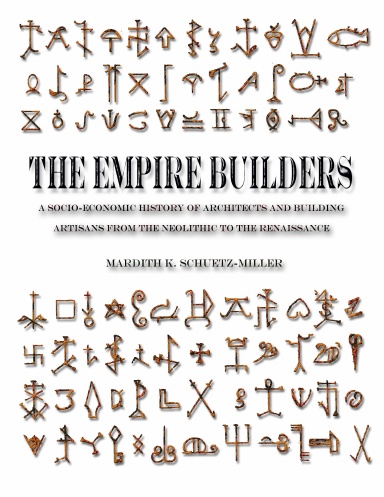
The Empire Builders. A Socio-Economic History of Architects and Building Artisans from the Neolithic to the Renaissance is a comparative study of the men who literally built the monumental architecture of Eurasia’s diverse civilizations up until modern times. Synthesizing data from many disciplines (ancient history and law, hieroglyphic and cuneiform texts, mythology, archaeology, guild records, literature, geophysics, and climatology) the building craftsmen are identified; their training, guild organizations, and construction rites described; and their status and life style examined. As a sequel to Pre-Euclidean Geometry and the Design of Mission Churches of the Spanish Borderlands (Special Issue, Journal of the Southwest, 2006) and Abodes for the Gods. The Symbolism of Ancient Sacred Architecture in Eurasia (Blue Oaks Arts, 2011) it answers more fully how the knowledge of the sacred geometry was transmitted through the millennia. This book is heavily illustrated and annotated.
Détails
- Date de publication
- Jul 20, 2011
- Langue
- English
- Catégorie
- Histoire
- Copyright
- Tous droits réservés - Licence de copyright standard
- Contributeurs
- Par (auteur): Mardith Schuetz-Miller
Caractéristiques
- Pages
- 397
- Type de reliure
- Livre à couverture souple Livre à couverture souple
- Couleur de l’intérieur
- Noir & Blanc
- Dimensions
- Lettre US (8,5 x 11 po / 216 x 279 mm)