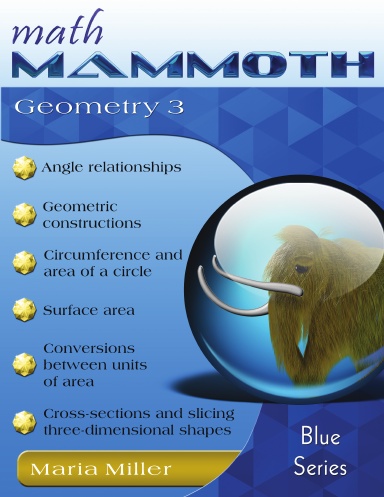
Math Mammoth Geometry 3 covers geometry topics for 7th grade level. The main topics students encounter are:
- some angle relationships
- pi and the area of a circle
- drawing geometric figures, including basic geometric constructions
- surface area, volume, and cross-sections of common solids.
In the first three lessons of the book, we examine various basic angle relationships: angles that are formed when several rays originate from the same starting point, supplementary angles (angles that add up to 180°), complementary angles (angles that add up to 90°), and vertical angles (formed when two lines intersect). Using these basic principles of angle relationships, students find unknown angles in a figure and write equations for those. Based on these basic angle relationships, they also write equations in more complex situations in the lesson Angle Relationships 3.
Then we turn our attention to pi. Students first learn the definition of pi as a ratio of a circle’s circumference to its diameter in the lesson Circumference of a Circle. They learn and practice how to calculate the area of a circle in a wide variety of word problems and applications.
We also briefly study the proof for the formula for the area of a circle. I feel it is important that students encounter justifications for mathematical formulas and procedures and even read some proofs before high school. We don’t want students to think that mathematics is only a bag of magic tricks or formulas to memorize that seemingly came out of nowhere. Proofs and logical thinking are foundations to mathematics and school mathematics should not be left without them. The Common Core Standards agree to this, as one of the standards for 7th grade is to "give an informal derivation of the relationship between the circumference and area of a circle."
Next, students will solve a variety of problems involving the area of circles in the lesson Problems Involving Circles. They will also study the area of polygons and compound shapes in one lesson.
Then it is time for another major topic of the book: drawing geometric figures. First, students draw shapes from the given information using a protractor and a ruler. Then they learn some basic geometric constructions, which are done just like in ancient times: with only a compass and straightedge (a ruler without measurement units). These constructions help students to think about the main defining features of a figure. Personally I
The answer key is appended.
Détails
- Date de publication
- Apr 1, 2014
- Langue
- English
- Catégorie
- Éducation & langues
- Copyright
- Tous droits réservés - Licence de copyright standard
- Contributeurs
- Par (auteur): Maria Miller
Caractéristiques
- Pages
- 105
- Type de reliure
- Livre à couverture souple Livre à couverture souple
- Couleur de l’intérieur
- Couleur
- Dimensions
- Lettre US (8,5 x 11 po / 216 x 279 mm)