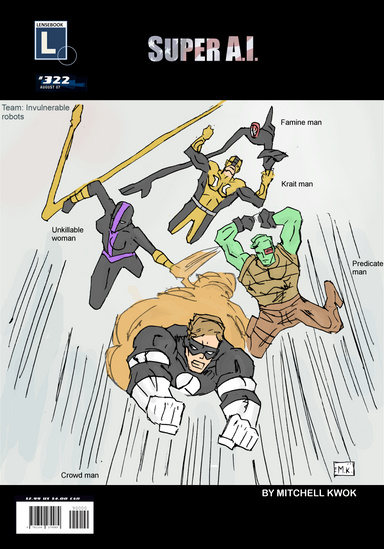
Super Ai #322
Organism Man and Organism woman: the true origins of mankind
Cet ebook peut ne pas être conforme aux normes d'accessibilité et ne pas être totalement compatible avec les technologies d'assistance.
In the early years, after solar systems were formed and planets can sustain life, the first intelligent being was created. It happened in a star called Nebulon 4B and this process of creating organic life spanned many generations and colonies, not to mention millions of years of evolution.
It all started with a cluster of atoms loosely located close to each other that through random happenstance and natural physics equations created the “first Turing machine.” At first it was just a single for-loop with a positive up and negative down motion, but from that simple for-loop it was able to form sophisticated circuits (or appendages) that function as conditions. This gave the entity a simple reinforcement behavior in which it uses to experience life.
In time, this living entity formed senses and a means to sustain its body for both energy and reproduction. The original for-loop evolved into a primitive brain with a set of processing units and memory to store data. It now has the ability to predict the future so that it can select actions that it can take to benefit itself for the long term future.
This brain was able to sense from the environment and to modify its own body according to a dynamic and 3-d environment. A head was formed to house the brain and to protect it from the elements, while its body and its appendages also evolved according to environmental conditions. The planet had a similar atmosphere like earth with the same gravitational pull. The intelligent entity, which I call Organism man, took generations to evolve into, and many bodies that were created and reproduced.
Détails
- Date de publication
- Jun 15, 2024
- Langue
- English
- ISBN
- 9781304279989
- Catégorie
- Bandes dessinées & romans graphiques
- Copyright
- Tous droits réservés - Licence de copyright standard
- Contributeurs
- Par (auteur): Mitchell Kwok
Caractéristiques
- Format