What remains when survival is no longer the organizing principle of human life?
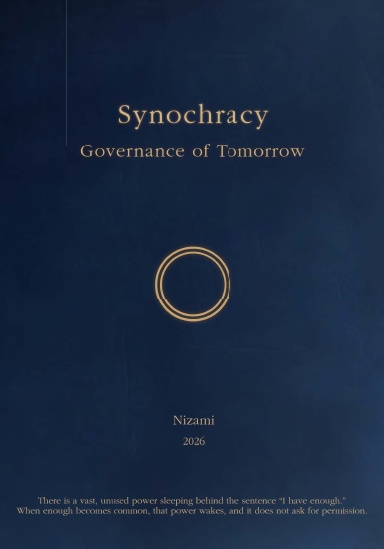
Synochracy is a proposal for governance organized around coherence rather than control.
It begins with a critique of the systems that shaped the modern world: capitalism, socialism, nationalism, democracy, and technocracy. Each is examined not as an enemy, but as an incomplete structure whose limits have become visible.
From there, the book proposes a new framework built on three principles: Humanity, Earth, and Knowledge.
Synochracy imagines public institutions, technology, economy, education, cities, healthcare, identity, justice, work, ownership, and daily life under a different form of collective organization. It also offers a transition model for moving from the present order toward one organized around transparency, stewardship, shared knowledge, and the protection of essential human dignity.
This is not a doctrine and not a final blueprint.
It is a model to be examined, challenged, corrected, and rebuilt where it fails.
For readers interested in future governance, political systems, social architecture, public institutions, sustainability, artificial intelligence, economics, and the possibility of organizing collective life beyond extraction, control, and permanent crisis.
Détails
- Date de publication
- Jul 25, 2026
- Langue
- English
- ISBN
- 9789923021521
- Catégorie
- Sciences humaines
- Copyright
- Tous droits réservés - Licence de copyright standard
- Contributeurs
- Par (auteur): Nizami
Caractéristiques
- Pages
- 217
- Type de reliure
- Livre à couverture souple Livre à couverture souple
- Couleur de l’intérieur
- Noir & Blanc
- Dimensions
- Exécutif (7 x 10 po / 178 x 254 mm)
Mots-clés
synochracygovernancefuture governancepolitical systemspublic policysocial architecturecoherent societypublic institutionssustainable developmentartificial intelligenceAI governancefuture societypost-capitalismsystems designstewardshiphumanity earth knowledgesocial transformationeconomic systemspublic economytransition modelcollective intelligencetransparencyfuture politics