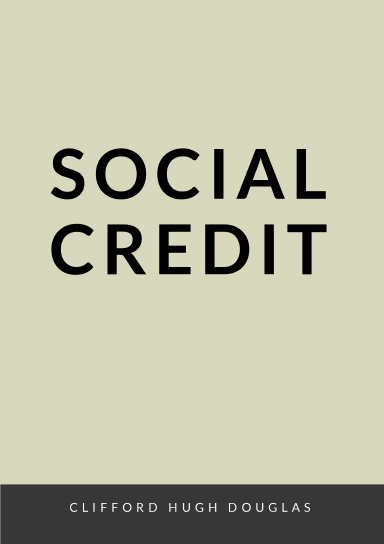
C. H. Douglas’s Social Credit (1924) reads less like a dry economics manual and more like a detective story about money—one in which the culprit is hidden in plain sight.
Douglas begins with an engineer’s eye for systems, describing how, in the modern industrial economy, goods pour off production lines in abundance, yet consumers never seem to have enough money to buy them all. He traces this paradox to what he calls the “gap” between prices and purchasing power: the total costs built into goods (including capital charges, bank interest, and overhead) consistently exceed the wages, salaries, and dividends paid out during their production. The result, he argues, is a chronic shortfall in consumer buying power, masked temporarily by debt, exports, or government spending.
From this diagnosis, Douglas unfolds his remedy as if revealing the missing piece of a machine. Money, he insists, should be a public instrument, issued in line with the nation’s real productive capacity rather than created as interest‑bearing debt by private banks. To bridge the gap, he proposes two key mechanisms:
A National Dividend—a regular, unconditional payment to every citizen, reflecting their shared inheritance in the accumulated knowledge, technology, and organization that make modern production possible.
A Just Price system—periodic adjustments to retail prices so they reflect the real cost of production, ensuring goods can be sold without inflating debt.
Douglas frames these ideas not as socialism or state control, but as a way to restore the true purpose of the economy: delivering goods and services to meet human needs, with finance serving production rather than dictating it. He blends technical explanation with moral argument, warning that without reform, the credit system will continue to ration abundance and distort social life.
By the end, Social Credit reads as both a blueprint and a challenge: if scarcity in an age of plenty is artificial, then the real task is to redesign the financial “machinery” so that it runs in the service of everyone, not just those who control the levers.
Dettagli
- Data di pubblicazione
- Sep 14, 2025
- Lingua
- English
- Categoria
- Affari e Economia
- Copyright
- Creative Commons Non commerciale, Non opere derivate (CC BY-NC-ND)
- Collaboratori
- Di (autore): C. H. Douglas
Specifiche
- Pagine
- 231
- Tipo di rilegatura
- Libro a copertina morbida Libro a copertina morbida
- Colore del contenuto
- Bianco e nero
- Dimensioni
- A5 (148 x 210 mm)