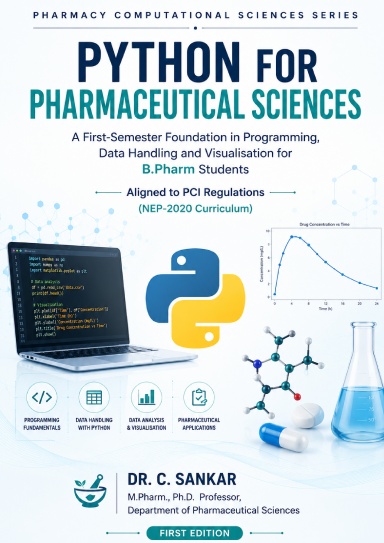
PYTHON FOR PHARMACEUTICAL SCIENCES: PHARMACY COMPUTATIONAL SCIENCES SERIES
Di solito viene stampato in 3-5 giorni lavorativi
This text has been written specifically for the course Basics of Python Programming for Pharmaceutical Sciences (BP101T), offered as part of the revised Bachelor of Pharmacy curriculum aligned with the National Education Policy (NEP) 2020 and circulated by the Pharmacy Council of India. It follows the five units of the prescribed syllabus in sequence — from installing Python and understanding variables, through control structures and functions, data structures and file handling, data analysis with pandas, and finally data visualisation with Matplotlib — and supplements each unit with pharmaceutical examples that a first-semester student will recognise: dosage calculators, BMI calculators, pharmacokinetic datasets, adverse drug reaction logs, and dissolution profiles.
Two convictions have shaped the way this book is written. The first is that programming is best learned by typing, running, breaking, and fixing code, not by reading about it. Every chapter therefore contains working code listings with their expected output, short guided exercises, and a set of end-of-chapter questions that mirror the internal assessment and end-semester examination pattern prescribed for this course. The second conviction is that a pharmacy student does not need to become a professional software engineer to benefit enormously from programming literacy; they need a calm, example-driven introduction that never loses sight of why a pharmacist would want to do this in the first place. I have tried, throughout, to keep the “why pharmacy needs this” question answered on every page.
This text has been written specifically for the course Basics of Python Programming for Pharmaceutical Sciences (BP101T), offered as part of the revised Bachelor of Pharmacy curriculum aligned with the National Education Policy (NEP) 2020 and circulated by the Pharmacy Council of India. It follows the five units of the prescribed syllabus in sequence — from installing Python and understanding variables, through control structures and functions, data structures and file handling, data analysis with pandas, and finally data visualisation with Matplotlib — and supplements each unit with pharmaceutical examples that a first-semester student will recognise: dosage calculators, BMI calculators, pharmacokinetic datasets, adverse drug reaction logs, and dissolution profiles.
Dettagli
- Data di pubblicazione
- Aug 19, 2026
- Lingua
- English
- Categoria
- Medicina & scienza
- Copyright
- Tutti i diritti riservati - Licenza di copyright standard
- Collaboratori
- Di (autore): Dr.C.Sankar Professor
Specifiche
- Pagine
- 105
- Tipo di rilegatura
- Libro a copertina morbida Rilegatura a spirale
- Colore del contenuto
- Bianco e nero
- Dimensioni
- A4 (210 x 297 mm)