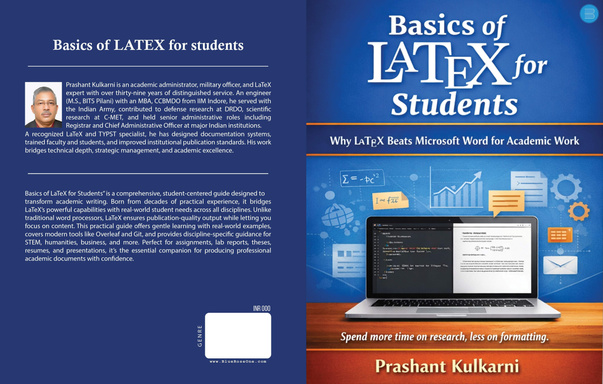
Basics of LaTeX for Students
Why LaTeX Beats Microsoft Word for Academic Work
Questo ebook potrebbe non soddisfare gli standard di accessibilità e non essere pienamente compatibile con le tecnologie assistive.
Academic writing demands more than just putting words on a page—it requires precision, consistency, clarity, and professional presentation. Whether you are preparing assignments, laboratory reports, research papers, dissertations, books, resumes, conference presentations, or academic posters, the quality of your document often influences how your work is perceived. Basics of LaTeX for Students: Why LaTeX Beats Microsoft Word for academic Work has been written to help students, researchers, educators, and professionals master one of the world's most powerful document preparation systems. Unlike traditional word processors that focus primarily on visual formatting, LaTeX separates content from presentation, allowing writers to concentrate on ideas while automatically producing beautifully formatted documents. This book explains not only how LaTeX works but also why it has become the preferred choice of universities, researchers, scientific publishers, and technical professionals around the world. Designed specifically for beginners, the book assumes no prior knowledge of programming or typesetting. It begins by introducing the LaTeX ecosystem, guiding readers through installation on Windows, macOS, Linux, and cloud-based platforms such as Overleaf. Step by step, readers learn how to create their first document before gradually progressing toward more advanced capabilities. The book provides detailed coverage of mathematical typesetting, enabling readers to write equations, matrices, theorems, proofs, scientific notation, and complex mathematical expressions with publication-quality accuracy. Through numerous practical examples, students learn techniques used by mathematicians, engineers, physicists, economists, statisticians, computer scientists, and researchers. Beyond mathematics, the book demonstrates how to insert figures, create professional tables, draw diagrams using TikZ, generate scientific plots with PGFPlots, and produce visually appealing technical documents. Readers discover efficient methods for managing references using BibTeX and BibLaTeX, ensuring that citations and bibliographies conform to academic standards while eliminating tedious manual formatting. One of the greatest strengths of this guide is its focus on real academic workflows. Complete chapters explain how to prepare journal articles, conference papers, undergraduate projects, postgraduate dissertations, doctoral theses, technical reports, books, professional resumes
Dettagli
- Data di pubblicazione
- Jul 18, 2026
- Lingua
- English
- Categoria
- Computer & tecnologia
- Copyright
- Tutti i diritti riservati - Licenza di copyright standard
- Collaboratori
- Di (autore): Prashant Kulkarni
Specifiche
- Formato
Parole chiave
LaTeXLearn LaTeXLaTeX for StudentsLaTeX TutorialLaTeX ProgrammingLaTeX TypesettingDocument PreparationAcademic WritingScientific WritingTechnical WritingResearch WritingThesis WritingDissertation WritingJournal Paper WritingConference Paper WritingResearch PaperMathematical TypesettingMathematical EquationsEngineering DocumentationScientific DocumentationOverleafBibTeXBibLaTeXTikZPGFPlotsBeamerModernCVLyXCross ReferencesBibliography ManagementCitation ManagementAcademic TemplatesLaTeX PackagesPDF TypesettingDocument FormattingBook WritingResume WritingPoster DesignTechnical ReportsPublishing & Productivity KeywordsProfessional DocumentsPublication ReadyJournal SubmissionThesis FormattingDissertation FormattingResearch ProductivityOpen Source SoftwareWorkflow AutomationVersion ControlGit for Researchers