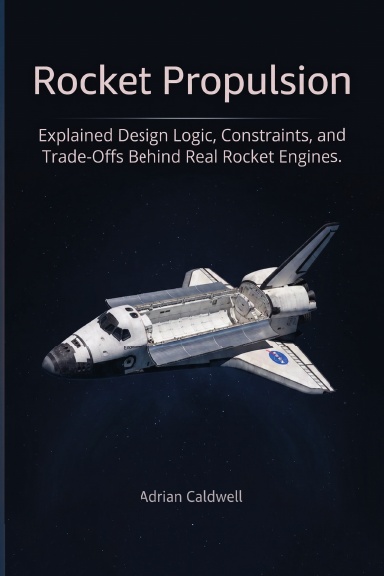
Rocket Propulsion
Explained Design Logic, Constraints, and Trade-Offs Behind Real Rocket Engines
Usually printed in 3 - 5 business days
Most books about rockets explain propulsion as if engines were elegant equations floating in a vacuum. Real rocket engines are nothing like that.
They are violent machines forced to survive impossible temperatures, unstable combustion, brutal pressure gradients, vibrating structures, razor-thin mass margins, and engineering decisions where improving one parameter often damages three others.
Rocket Propulsion Explained is not a catalog of engines or a simplified “how rockets work” introduction. It is a deep conceptual guide to the engineering logic behind propulsion systems — the hidden reasoning that determines why real rocket engines look, behave, and fail the way they do.
Instead of drowning the reader in equations, the book rebuilds intuition from first principles:
what thrust actually is,
why exhaust velocity dominates rocket design,
why no nozzle is truly optimal,
why high performance engines become thermally and structurally terrifying,
and why propulsion engineering is ultimately the art of managing impossible compromises.
The book explores propulsion not as isolated physics, but as a systems engineering problem where chemistry, thermodynamics, structures, turbomachinery, cooling, manufacturing, operations, reliability, and mission design constantly collide.
Inside the book:
Why rockets feel counterintuitive compared to aircraft and cars
Why “burning fuel” is a misleading mental model
How engineers think about momentum, mass flow, and exhaust velocity
The hidden meaning — and limitations — of specific impulse
Why rockets are fundamentally mass-limited machines
The real logic behind staged combustion, gas-generator, and pressure-fed cycles
Why nozzle geometry defines engine behavior
How altitude changes propulsion performance
Why combustion is often easier than cooling the engine
Thermal limits, regenerative cooling, and survivability
Combustion instability and destructive feedback loops
Why the highest-performance engine is often the wrong choice
Electric propulsion, efficiency trade-offs, and future propulsion concepts
How real propulsion engineers reason under uncertainty and constraints
The central theme of the book is simple:
Rocket engines are not optimized toward perfection — they are optimized toward survivability, manufacturability, controllability, and mission success.
Written for engineering students, propulsion enthusiasts, aerospace professionals, and technically curious readers, Rocket Propulsion Explain
Details
- Publication Date
- Jun 14, 2026
- Language
- English
- Category
- Engineering
- Copyright
- All Rights Reserved - Standard Copyright License
- Contributors
- By (author): Adrian Caldwell
Specifications
- Pages
- 174
- Binding Type
- Paperback Perfect Bound
- Interior Color
- Black & White
- Dimensions
- US Trade (6 x 9 in / 152 x 229 mm)