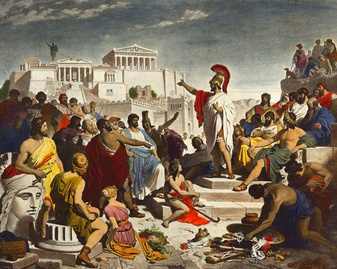
Hellenic Religion, Mythology, Anthropology
This ebook may not meet accessibility standards and may not be fully compatible with assistive technologies.
The religious beliefs and practices of the ancient Hellenes or in short, Greek religion is not the same as Greek mythology, the latter being concerned with traditional tales, although the two are closely interlinked. Curiously, for a people so religiously minded, the Greeks had no word for religion itself; the nearest terms were eusebeia (“piety”) and threskeia (“cult”).
Although its origins may be traced to the remotest eras, Greek religion in its developed form lasted more than a thousand years, from the time of Homer (probably 9th or 8th century BC) to the reign of the emperor Julian (4th century AD). During that period, its influence spread as far west as Spain, east to the Indus River, and throughout the Mediterranean world. Its effect was most marked on the Romans, who identified their deities with those of the Greeks.
Under Christianity, Greek heroes and even deities survived as saints, while the rival madonnas of southern European communities reflected the independence of local cults. The rediscovery of Greek literature during the Renaissance and, above all, the novel perfection of Classical sculpture produced a revolution in taste that had far-reaching effects on Christian religious art. The most striking characteristic of Greek religion was the belief in a multiplicity of anthropomorphic deities under one supreme god. Priests simply looked after cults; they did not constitute a clergy, and there were no sacred books.
Details
- Publication Date
- Apr 30, 2021
- Language
- English
- ISBN
- 9781667125879
- Category
- Reference
- Copyright
- All Rights Reserved - Standard Copyright License
- Contributors
- By (author): Andreas Sofroniou
Specifications
- Format
- EPUB