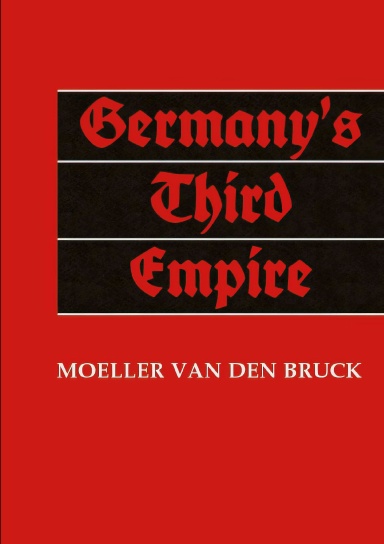
In Germany’s Third Empire, Arthur Moeller van den Bruck presents a sweeping critique of Weimar Germany and a visionary framework for national renewal. Written in 1923, the book proposes the concept of a “Third Empire” (Das Dritte Reich)—intended not as a literal regime, but as a symbolic culmination of German cultural and political evolution, following the Holy Roman Empire and Bismarck’s Second Empire.
Moeller van den Bruck argues that Germany’s postwar malaise results from spiritual decay and ideological fragmentation. He dismisses prevailing systems like liberalism, socialism, and parliamentary democracy as inadequate for restoring national purpose. Instead, he advocates for a new synthesis: authoritarian leadership rooted in German tradition, Prussian discipline, and a rejection of Western materialism.
The book envisions a future Germany governed by an elite capable of guiding a unified national community. Although Moeller was impressed by Mussolini’s model, he was critical of Adolf Hitler, whom he considered lacking in philosophical and intellectual depth. Nevertheless, the term “Third Empire” was later appropriated by the National Socialist movement to describe their regime, even though Moeller’s vision was more cultural and philosophical than strictly political.
As a foundational text in the Conservative Revolution, Germany’s Third Empire reflects the anxieties of the interwar period and the yearning for national rebirth. It blends cultural critique with ideological exploration and remains significant for its influence on later nationalist thought.
Details
- Publication Date
- Jul 16, 2025
- Language
- English
- Category
- Social Science
- Copyright
- Creative Commons NonCommercial, NoDerivatives (CC BY-NC-ND)
- Contributors
- By (author): Arthur Moeller van den Bruck
Specifications
- Pages
- 248
- Binding Type
- Paperback Perfect Bound
- Interior Color
- Black & White
- Dimensions
- A5 (5.83 x 8.27 in / 148 x 210 mm)