Popular Hebrew Script
& Authentic Phonology
This ebook may not meet accessibility standards and may not be fully compatible with assistive technologies.
You have seen the Hebrew alphabet a thousand times. This book is for the second look—where you notice a four-headed shin on Tefillin and realize no textbook mentioned it; where you ask why your grandfather's taw sounded like an "s" and your teacher's does not; where you wonder whether the pronunciation you were taught is the tradition or only the survivor.
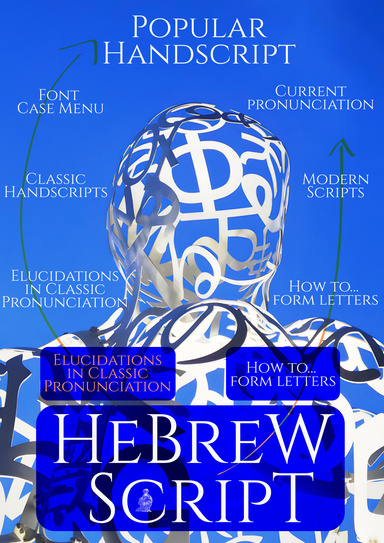
A drawing manual and a font menu. Every letter is taught stroke by stroke, then shown in its whole family of shapes—Ashkenazi and Sephardi Stam, Rashi, Vilna, Solitreo, David, and the everyday handscripts—so the eye can compare instead of guess.
The A-page: the modern pronunciation, as spoken today. The facing B-page: the mining operation—through the Rishonim, Saadya Gaon, Sefer Yetzirah, and the living reading traditions recorded by Bension Kohen of Djerba—in search of the authentic sound. Not what the letter has become, but what it was, and where it is still alive. Each phoneme is anchored in examples from other languages, so every reader begins from a sound he already owns.
The forgotten letters. The four-headed shin · pe kefula · taw and saw · ghimel and rimel · daleth and thaleth · final kaf and the only vowels it can carry · six pages on resh, the seventh doubled letter, with dagesh qal and hazaq, which most grammars quietly dropped. Visual rosettes make the laws of dagesh graspable at a glance.
The detective story. A 180-page investigation into what became of the phonetic Ashkenazi mesorah—through genetics, history, geography, manuscripts, archaeology, oral tradition, and plain logic—and the case, fact by fact. You may not agree with every page; you will not be able to say the case was not made or that inconvenient evidence was left out.
Contemporary manuals give the twenty-two letters a page or two, but they bypass the difficulties. There are more than twenty-two, if you know where to look. Here: 90+ pages on phonology directly, in a 376-page reference distilled from seven years of research—restoring Hebrew to what the Tanakh calls it: Yehudith, the language of Yehuda.
For the calligrapher, the baal koreh, the student, the teacher who has run out of answers, and every reader who suspects the liturgy deserves its genuine pronunciation.
סוֹמֵךְ נוֹפְלִים—What was falling out of the world is held up by hands that never let go. Those hands belonged to great-grandfathers whose voices went quiet too soon. This book is how you become one of them.
All set up and ready.
Details
- Publication Date
- Aug 13, 2026
- Language
- English
- ISBN
- 9781291571530
- Category
- Education & Language
- Copyright
- All Rights Reserved - Standard Copyright License
- Contributors
- By (author): Aser Efraim Pusztai
Specifications
- Format
Keywords
Hebrew handscriptHebrew Classic PhoneticsHebrew Biblical PhonologyTiberian PronunciationAuthenthic Hebrew enunciationYemenite pronunciationJewish Tunisian articulationRashi scriptStam scriptAshkenazi fontsAbout Hebrew fontsShlomo Ibn GabriolHebrew primerHebrew readerHebrew alphabet bookHebrew alphabetRabbi Ben Sion KohenRabbi David Bar-HayimMachon ShiloSolitreoSolitreo hanscriptSyrian Jewish AlphabetAshkenazi mesorahSephardi mesorahTalmud YerushalmiHebrew caligraphyYehudithbegadkefat letterssoft gimel pronunciationdagesh and rafespirantization Hebrewlost Hebrew consonantsHebrew letters that changed soundHebrew reading traditionsmasoretic pronunciationSpanish and Portuguese JewsSephardi Hebrew pronunciationHebrew letterformsHebrew calligraphy letterswriting systems Semiticlearn Hebrew pronunciationHebrew for adult beginnerspronounce Hebrew correctlyHebrew phonetics guidehistorical Hebrew phonology reading traditionslost Hebrew consonants pronunciation shiftSephardi minhag Torah reading baal keriahlearn correct Hebrew pronunciation adultsHebrew reading traditions Sephardi AshkenaziHebrew phonetics for Torah readers