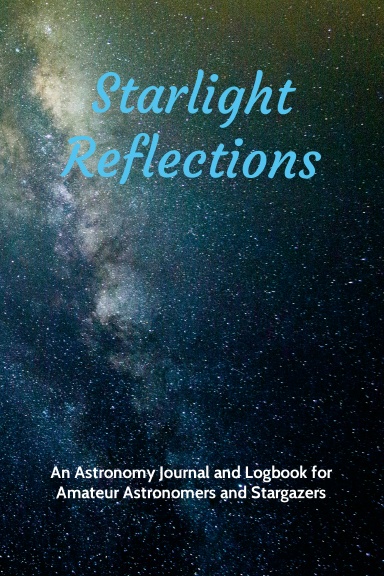
Starlight Reflections
An Astronomy Journal and Logbook for Amateur Astronomers and Stargazers
Usually printed in 3 - 5 business days
Whether you're an experienced astronomer or simply an enthusiastic stargazer, this logbook is designed to help you record and track your celestial observations with precision and detail. With a thoughtful layout that caters to astronomers of all levels, Starlight Reflections offers a unique way to document and reflect on your stargazing experiences.
Each page in this astronomy logbook is dedicated to recording a single night's observations. The log entries include the following essential details:
Date: Record the date of your observation, ensuring you can easily track your progress over time
Time: Note the start and end times of your stargazing session, helping you understand how long you spent observing and at what hour you saw specific celestial objects
Location: Write down the location where your observations took place, including any relevant details such as city, state, or national park
GPS Coordinates: Record the GPS coordinates (latitude, longitude) of your observation site, allowing you to pinpoint exactly where you made each observation on a map
Elevation: Note the elevation of your observation site, which can impact the clarity and visibility of celestial objects
Sky Conditions: Describe the atmospheric conditions on the night of your observation, including factors like cloud cover, humidity, temperature, and wind speed, all of which can influence what you're able to see in the sky
Lunar Phase: Record the lunar phase at the time of your observations, helping you understand how the moon's position might have affected your viewing experience
Seeing and Transparency Conditions: Assess the seeing conditions (the steadiness of the air) and transparency (clarity of the atmosphere) on the night of your observation, as these factors can significantly impact the quality of your views
Magnitude: Note the brightness of the object you observed, ranging from 1 (brightest) to 6 (faintest)
Type: Identify the type of celestial object you saw, such as star, planet, galaxy, nebula, or other
Right Ascension (RA): Record the RA of your observed object in hours, minutes, and seconds, helping you locate it on a star chart or using astronomy software
Declination (Dec): Note the Dec of your observed object in degrees, minutes, and seconds, which will aid in pinpointing its location in the sky
Nearest Constellation: Identify the constellation nearest to the object you observed, providing context for its position in the night sky
Details
- Publication Date
- Nov 8, 2025
- Language
- English
- Category
- Science & Medicine
- Copyright
- All Rights Reserved - Standard Copyright License
- Contributors
- By (author): Aurorae Hayley
Specifications
- Pages
- 51
- Binding Type
- Paperback Perfect Bound
- Interior Color
- Black & White
- Dimensions
- US Trade (6 x 9 in / 152 x 229 mm)