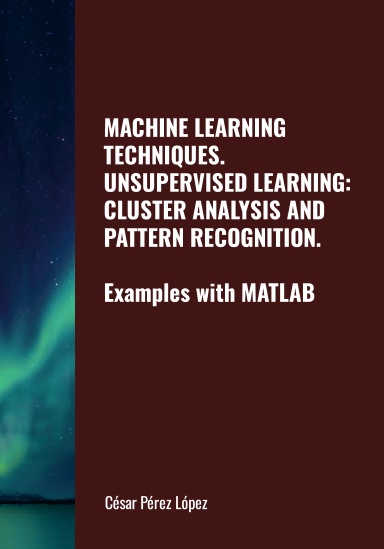
MACHINE LEARNING TECHNIQUES: UNSUPERVISED LEARNING: CLUSTER ANALYSIS AND PATTERN RECOGNITION. EXAMPLES WITH MATLAB
Usually printed in 3 - 5 business days
Artificial Intelligence combines mathematical algorithms and techniques from Machine Learning, Deep Learning and Big Data to extract the knowledge contained in the data and present it in an understandable and automatic way. Machine learning uses two types of techniques: supervised learning, which trains a model on known input and output data so that it can predict future outputs, and unsupervised learning, which finds hidden patterns or intrinsic structures in input data. Unsupervised learning finds hidden patterns or intrinsic structures in data. It is used to draw inferences from datasets consisting of input data without labeled responses. Clustering is the most common unsupervised learning technique. It is used for exploratory data analysis to find hidden patterns or groupings in data. Applications for clustering include gene sequence analysis, market research, and object recognition. This book develops Unsupervised Cluster Analysis, Clustering with Neural Networks, Self Organizing Map Neural Networks, Competitive Neural Networks, Competitive Layers, Classify Patterns with Neural Network, Pattern Recognition, Multilayer Neural Networks, Parallel Computing, GPU Computing, Optimal Solutions, Autoencoders, Transfer Learning, Convolutional Neural Networks, Image Classification, and Character Recognition
Details
- Publication Date
- Aug 4, 2024
- Language
- English
- ISBN
- 9781445230351
- Category
- Computers & Technology
- Copyright
- All Rights Reserved - Standard Copyright License
- Contributors
- By (author): Cesar Perez Lopez
Specifications
- Pages
- 351
- Binding Type
- Paperback Perfect Bound
- Interior Color
- Black & White
- Dimensions
- Executive (7 x 10 in / 178 x 254 mm)
Keywords
MATLABARTIFICIAL INTELLIGENCEMACHINE LEARNINGUNSUPERVISED LEARNINGCLUSTER AALYSISPATTERN RECOGNITIONCLUSTERING WITH NEURAL NETWORKSPATTERN RECOGNITION WITH NEURAL NETWORKSSELF ORGANIZING MAP NETWORKSCOMPETITIVE NETWORWORKSCOMPETITIVE LAYERSSOM KOHONENSOMKOHONENMULTILAYER NEURAL NETWORKSCONVOLUTIONAL NEURAL NETWORKSAUTOENCODERSCHARACTER RECOGNITIONTRANSFER LEARNINGIMAGE CLASSIFICATIONPARALLEL COMPUTINGGPU COMPUTINGOPTIMAL SOLUTIONS