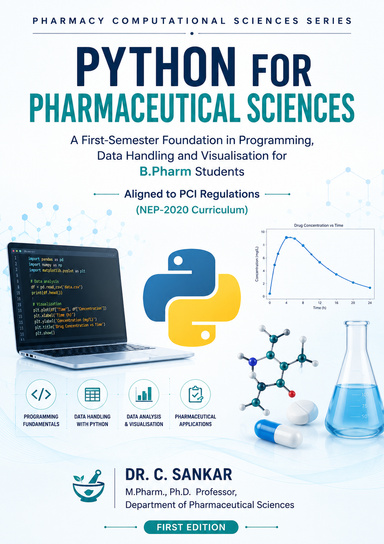
PYTHON FOR PHARMACEUTICAL SCIENCES: PHARMACY COMPUTATIONAL SCIENCES SERIES
This ebook meets accessibility standards and is compatible with assistive technologies. Accessibility compliance is determined by the publisher and creator.
Pharmacy has always been a science of precision. From the first mortar and pestle to the modern dissolution apparatus, the profession has evolved by adopting whatever tools allow it to measure, verify, and communicate more exactly. Today that tool is, increasingly, the computer — and more specifically, the Python programming language. This book is written in the belief that a pharmacy graduate who can write ten lines of Python to summarise a batch of assay results, plot a concentration-time curve, or clean a spreadsheet of adverse drug reaction reports is better equipped for modern practice than one who cannot, regardless of whether that graduate goes on to a hospital, an industry laboratory, a regulatory desk, or a research career.
No prior programming background is assumed. Where a computing concept is genuinely difficult on first encounter — recursion is deliberately not covered, nested list comprehensions are kept to a minimum, object-oriented programming is left for a later course — the treatment has been simplified in favour of building confidence and correctness first. Students who wish to go further will find recommended references at the end of each unit and in the appendices.
I am grateful to the Pharmacy Council of India and the Education Regulations Committee This text has been written specifically for the course Basics of Python Programming for Pharmaceutical Sciences (BP101T), offered as part of the revised Bachelor of Pharmacy curriculum aligned with the National Education Policy (NEP) 2020 and circulated by the Pharmacy Council of India. It follows the five units of the prescribed syllabus in sequence — from installing Python and understanding variables, through control structures and functions, data structures and file handling, data analysis with pandas, and finally data visualisation with Matplotlib — and supplements each unit with pharmaceutical examples that a first-semester student will recognise: dosage calculators, BMI calculators, pharmacokinetic datasets, adverse drug reaction logs, and dissolution profiles.
Details
- Publication Date
- Aug 19, 2026
- Language
- English
- Category
- Science & Medicine
- Copyright
- All Rights Reserved - Standard Copyright License
- Contributors
- By (author): Dr.C.Sankar Professor
Specifications
- Format
- EPUB