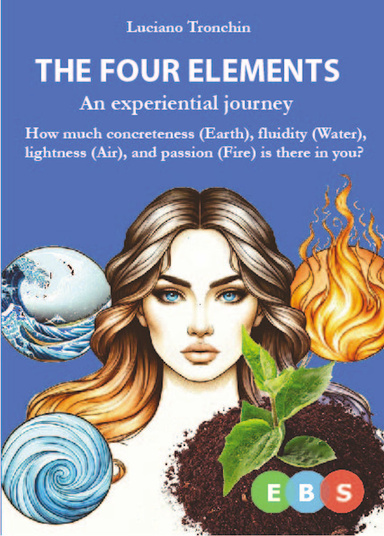
The four elements
An experiential journey
This ebook meets accessibility standards and is compatible with assistive technologies. Accessibility compliance is determined by the publisher and creator.
The essay "The Four Elements: An Experiential Path" by Luciano Tronchin explores the deep connection between the human being and the primordial elements (Earth, Water, Air, Fire), integrating ancient philosophy, depth psychology and ecology in a practical method aimed at psychophysical well-being.
Below is a summary of the key points of the work:
1. Philosophical and Historical Foundations
The author traces the origins of the concept of arché in archaic Greece, citing Empedocles as the first to theorize the "four roots" of matter. The cohabitation between mythos and logos is analyzed, suggesting that scientific progress should not abandon myth, but refine it to alleviate the suffering of modern man.
2. The Contribution of Gaston Bachelard and Carl Jung
The text rests on two pillars of psychology and epistemology:
• Gaston Bachelard: His "psychoanalysis of objective knowledge" and the concept of material imagination are examined. According to Bachelard, every dreamer is faithful to an element that orients his vision of the world and his creativity.
• Carl Gustav Jung: The elements are related to the four psychological functions (Thought-Air, Feeling-Water, Sensation-Earth, Intuition-Fire). The balance between these functions is the basis of the process of individuation and psychic fullness.
3. Experiential Approach: Biodanza and Multisensory Laboratory
The central part of the essay describes the translation of these abstract concepts into bodily practices:
• Biodanza: Based on the work of Rolando Toro, specific dances (such as those of the four animals or angels) are illustrated to integrate the inhibited elements into the personality.
• Multisensory Laboratory: An "enriched" environment where visual, auditory (frequencies at 432 Hz) and tactile stimuli help to awaken genetic potentials and promote neuronal plasticity.
• Tetragrammaton: A diagnostic tool used to map the balance of elements in an individual and guide inner transformation.
4. Ecology and Final Synthesis
The work concludes with a profound reflection on human ecology, emphasizing how the protection of the external environment is inseparable from the care of one's own internal balance. The experience ideally ends with organic writing (poetry), a means to fix emotional experiences and celebrate the new balance achieved.
Details
- Publication Date
- Jan 10, 2026
- Language
- English
- ISBN
- 9781291862553
- Category
- Personal Growth
- Copyright
- All Rights Reserved - Standard Copyright License
- Contributors
- Translated by: English Edition
Specifications
- Format
- EPUB