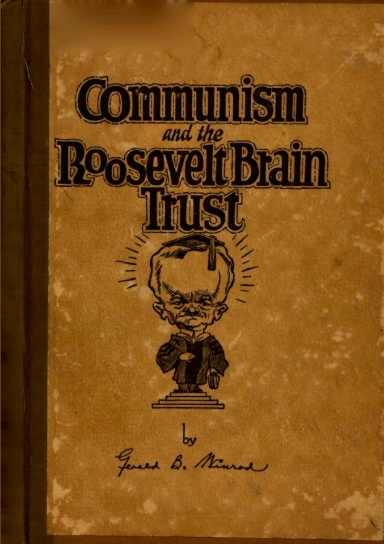
Communism and the Roosevelt Brain Trust
Usually printed in 3 - 5 business days
In Communism and the Roosevelt Brain Trust, Gerald B. Winrod presents a polemical critique of President Franklin D. Roosevelt’s administration, focusing on what he perceives as ideological and moral threats posed by members of the so-called “Brain Trust.” Published in 1933, the booklet reflects Winrod’s broader concerns about communism, secularism, and the erosion of traditional Christian values in American governance.
The narrative begins with Winrod’s assertion that Roosevelt’s advisors—many of whom were academics and reform-minded intellectuals—were influenced by socialist or communist ideas. He argues that their policy proposals, particularly those related to economic planning and social welfare, mirror principles found in Marxist doctrine. Winrod frames these developments as part of a larger trend toward collectivism and centralized control, which he believes undermines individual liberty and religious faith.
Throughout the text, Winrod draws connections between the New Deal’s early initiatives and what he views as subversive ideological currents. He expresses concern that the federal government is expanding its reach into private enterprise, education, and family life, and warns that such expansion could lead to moral decay and authoritarianism.
Details
- Publication Date
- Jul 15, 2025
- Language
- English
- Category
- Social Science
- Copyright
- Creative Commons NonCommercial, NoDerivatives (CC BY-NC-ND)
- Contributors
- By (author): Gerald B. Winrod
Specifications
- Pages
- 26
- Binding Type
- Paperback Saddle Stitch
- Interior Color
- Black & White
- Dimensions
- A5 (5.83 x 8.27 in / 148 x 210 mm)