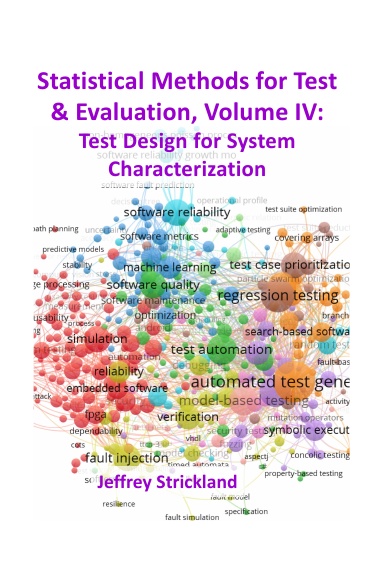
Statistical Methods for Test and Evaluation, Volume 4
Experimental Design using R
Usually printed in 3 - 5 business days
One of the key objections to testing as a form of software verification is that it is never possible to show that the system under test (SUT) works for all possible inputs. Combinatorial Test Design (CTD) is an optimal approach that helps us identify the tests that are likely to expose defects. CTD takes a systematic approach to modeling the things that need to be tested, then uses advanced mathematics to dramatically reduce the number of test cases while ensuring coverage of conditions and interactions. Used with Covering Arrays, CTD offer ways to build on existing techniques for input space partitioning, to provide more rigorous testing.
The advent of computers and telecommunication systems underlined the importance of thoroughly testing software and hardware-software systems. Software engineers tried using OAs to include all pairs of test settings, but quickly realized the limitations of OA-based test suites. Often, an OA matching the required combinatorial test structure did not exist, and OA-based test suites tended to include invalid (nonexecutable) test cases.
System failures often result from the interaction of conditions that might be innocuous individually, so combinatorial testing can be effective for domains with many interacting parameters, such as aerospace applications. Research suggests that in some circumstances, covering four-way to six-way combinations can be nearly as effective as testing all possible combinations, often dramatically reducing the number of test cases.
Details
- Publication Date
- Jun 30, 2024
- Language
- English
- ISBN
- 9781304262257
- Category
- Computers & Technology
- Copyright
- Creative Commons NonCommercial, ShareAlike (CC BY-NC-SA)
- Contributors
- By (author): Jeffrey Strickland
Specifications
- Pages
- 518
- Binding Type
- Hardcover Case Wrap
- Interior Color
- Color
- Dimensions
- US Trade (6 x 9 in / 152 x 229 mm)
Keywords
DOEDesign of ExperimentsExperimental DesignProbability of EffectivenessWeapon System EffectivenessMathematical ModelingCircular Error ProbableConditional ProbabilityFactorial DesignsRandmized Block DesignsFractional Factorial DesignsConfounded Block DesignResponse Surface DesignsCompletely Randmized Designs