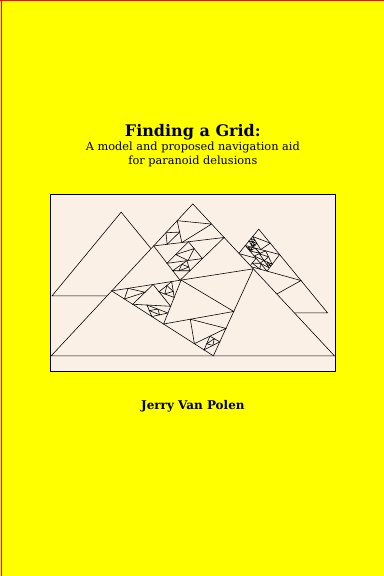
Finding a Grid
A model and proposed navigation aid for paranoid delusions
Usually printed in 3 - 5 business days
The author experienced paranoid delusions for seven years and continued to analyze them for another seven years.
From the back cover, an excerpt from chapter one, presenting a just-so linear account of moving into paranoid delusions:
1. You carry your attention and proximity to yourself everywhere.
2. If you learn to convert your attention and/or effects of proximity into "evidence" (perhaps by accepting low signal-to-noise ratio), then you can find "strange evidence" *everywhere*, potentially in distracting/compulsive quantity.
3. If you find "strange evidence" in distracting/compulsive quantity, you will need to create "strange hypotheses" to explain finding "strange evidence" anywhere and everywhere; as a corollary, "strange hypotheses" need to embody expansive scale.
4. Identifiable standard categories of "strange hypotheses" appear to include: a) the super-natural; b) the super-technological; and c) the super-social.
5. There are also identifiable categories of common "strange evidence"; these categories include: a) seeing time-concidences; b) completing chains-of-association; c) both (a) and (b) in some divination; and d) taking pre-defined associations personally when in proximity.
6. Together, listed categories of strange evidence vs. listed categories of strange hypotheses suggest a grid; in a sense, the "headspace" of delusional paranoia might thus be navigated with reference to said grid; this could be of use to those experiencing such paranoia.
7. In terms of delusional paranoia as a philosophical disease, the *consititutive criteria* for the implied grid appear to be:
- Categories of strange evidence must rationally explain a person's ability to find strange evidence anytime, anywhere, almost at will.
- Categories of strange hypotheses must *disease-like "explain"* finding evidence essentially everywhere.
8. The preceding epistemic view implies one-way development from "strange evidence" to "strange hypotheses"; an actual *etiology*/*prodrome* -- i.e., path to a maximal endpoint -- is likely to involve mutually-amplifying multi-way interactions.
Details
- Publication Date
- Jul 16, 2024
- Language
- English
- Category
- Science & Medicine
- Copyright
- Creative Commons Zero (CC 0)
- Contributors
- By (author): Jerry Van Polen
Specifications
- Pages
- 72
- Binding Type
- Paperback Perfect Bound
- Interior Color
- Black & White
- Dimensions
- US Trade (6 x 9 in / 152 x 229 mm)