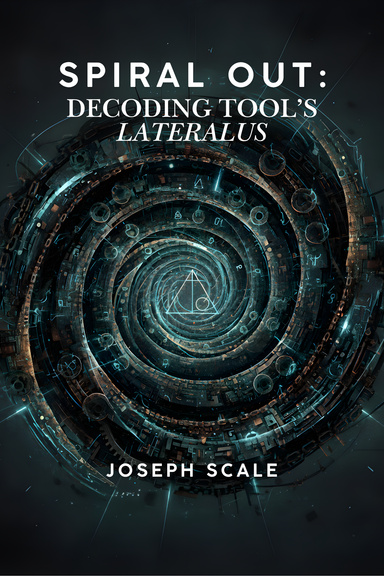
Spiral Out
Decoding Tool's Lateralus
This ebook meets accessibility standards and is compatible with assistive technologies. Accessibility compliance is determined by the publisher and creator.
Since its release in 2001, Tool's Lateralus has been widely recognized as a landmark achievement in progressive metal. Yet, popular discourse has barely scratched the surface, often fixating solely on the title track's famous Fibonacci sequence and 9/8-8/8-7/8 time signature.
Spiral Out: Decoding Tool's Lateralus provides a comprehensive, macro-structural compositional analysis of the entire thirteen-track cycle. Moving far beyond mathematical Easter eggs, this book reveals how drummer Danny Carey and guitarist Adam Jones employ complex rhythmic, metric, and harmonic devices to construct a highly cohesive aesthetic.
Inside, you will explore:
- Rhythmic Algorithmicism: An exhaustive look at additive rhythms, metric modulation, and how polymeter generates dramatic tension in tracks like "The Grudge" and "Schism".
- Tonal Language: A detailed examination of Tool's non-functional harmony, reliance on open fifths, and the modal explorations that define their heavy, ambiguous soundscape.
- The Algorithmic Narrative: How the album's structural expansion and Golden Ratio proportions directly mirror the alchemical Magnum Opus and Jungian individuation.
Details
- Publication Date
- Mar 24, 2026
- Language
- English
- Category
- Music
- Copyright
- All Rights Reserved - Standard Copyright License
- Contributors
- By (author): Joseph Scale
Specifications
- Format
- EPUB
Keywords
Tool band analysisLateralus music theoryDanny Carey drummingAdam Jones guitar styleJustin Chancellor bassProgressive metal albumsRhythmic analysisPolymeter and odd time signaturesAlgorithmic compositionNon-functional harmonyProgressive rock musicologyDrum theory and metric modulationFibonacci sequence in musicGolden Ratio in artJungian psychology and musicAlchemy and HermeticismMusic and mathematicsHeavy metal criticismMusic theory for rock musiciansAcademic music analysisPost-tonal popular music