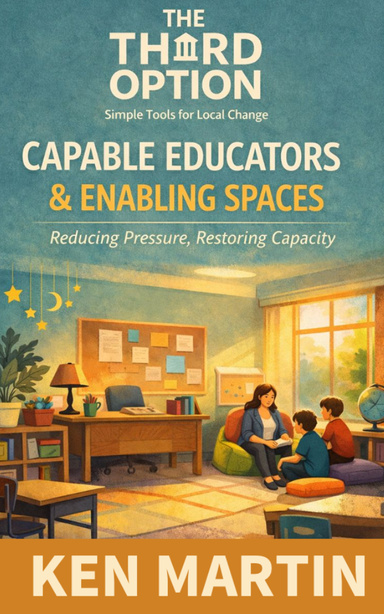
Capable Educators and Enabling Spaces
A Third Option Education Mini-Guide
This ebook may not meet accessibility standards and may not be fully compatible with assistive technologies.
If you spend any time on social media or read the education press, one theme keeps surfacing: teachers are exhausted, classrooms feel harder to hold, behaviour escalates faster, and the workload never really recedes.
This is no longer a fringe complaint. It’s part of the public conversation, appearing in headlines, staff surveys, and everyday conversations between teachers who once coped and now struggle to recover.
What matters is this. That exhaustion is not accidental. It is produced. It is the predictable outcome of systems that demand constant adaptation without stabilising conditions.
Sir Ken Robinson spoke for years about creativity, human potential, and the damage done when systems squeeze the life out of learning. He was clear that creativity does not survive in environments dominated by fear, pressure, and constant compliance. It needs space, rhythm, and trust to take root.
That point feels even more relevant now.
The problem is not passion or skill. It is the conditions. When pressure drains capacity, creativity never gets a foothold and survival behaviour takes over.
That is why this new mini guide starts where many discussions avoid, with adult pressure.
The guide is not professional development. It does not ask teachers to try harder, care more, or innovate faster. It does not introduce a programme, framework, or new expectations. It is not a wellbeing or resilience initiative.
Instead, it focuses on small stabilisations inside the working day.
Micro-routines that reduce cognitive load. Predictable lesson starts. Fewer noisy transitions. Finishable tasks that make thinking visible. Calmer spaces that do some of the work for you.
- Nothing new to manage.
- Nothing to take home.
- Nothing to justify.
There is a clear warning. If this adds work, marking, planning, tracking, or explanation, stop. It is being misused. This approach only works when leaders protect conditions rather than expand requirements.
The guide also names its limits. It is not a behaviour intervention. It does not fix unsafe classrooms. Where teachers lack control over space or rhythm, pressure reduction has to come first at a structural level.
This is not only a message for teachers. It is for school leaders and system designers. Pressure is not a personal failing. It is a design choice.
When adults stabilise, judgment returns. When judgment returns, creativity becomes possible again. Not as performance. Not as pressure. As normal practice.
Details
- Publication Date
- Dec 17, 2025
- Language
- English
- Category
- Education & Language
- Copyright
- All Rights Reserved - Standard Copyright License
- Contributors
- By (author): Ken Martin
Specifications
- Format