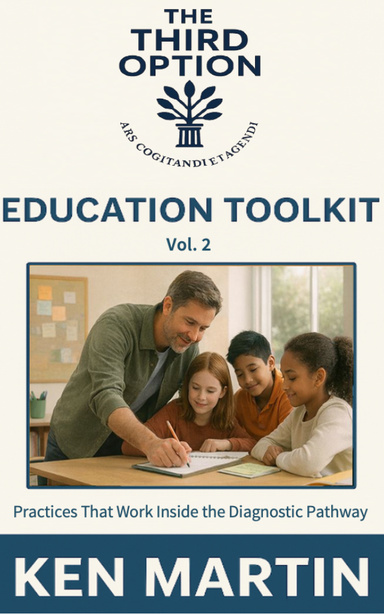
Education Toolkit Vol. 2
A Third Option Education Toolkit
This ebook may not meet accessibility standards and may not be fully compatible with assistive technologies.
As my work on architecture for education matures, some important changes where
tools stop being the starting point.
With the development of the Diagnostic Pathway and the Pillar Guides for Education, they have clarified something many schools already feel. Problems do not sit at the surface. They sit in conditions. Judgement under pressure. Work that never quite finishes. Rhythm that breaks attention. Care carried privately.
That clarity matters for how practices are used.
Education Toolkit Vol. 1 has not changed because the tools were wrong. It has changed because the sequence around them is now explicit. The toolkit now sits where it belongs. Downstream of diagnosis. Downstream of conditions. Inside judgement, not ahead of it.
I have now mapped the practices directly to the pillars they support. This matters more than it sounds. It stops tools being used as fixes and starts them being used as supports.
The sequence is simple.
First, the Diagnostic Pathway helps leaders slow down safely and understand what is actually happening. Symptoms are separated from causes. Pressure is stabilised before action.
Next, the Pillar Guides explain what is under strain. Is judgement collapsing into speed. Is work failing to complete. Is rhythm broken. Is care being absorbed privately.
Only then does the Toolkit come into play. Practices are chosen because they support a specific condition, not because they are fashionable or urgent.
For example, if effort feels high but evidence is thin, the pillar points to capability through completion. The toolkit then offers practices that protect finishing and revision. If attention scatters and behaviour carries the load, the pillar points to rhythm, and the practices focus on pacing and transitions. If judgement is collapsing, tool use slows first.
The toolkit now makes this explicit. It includes conditions for use, signals to pause, and clear guidance on when not to act yet. That is not caution for its own sake. It is duty of care.
Teachers benefit from this as much as leaders. When a practice does not land, the question shifts from “what did we do wrong” to “was the system ready”.
This is not a new toolkit. It is a safer one.
The practices are the same. The architecture around them has grown up.
Details
- Publication Date
- Dec 16, 2025
- Language
- English
- Category
- Education & Language
- Copyright
- All Rights Reserved - Standard Copyright License
- Contributors
- By (author): Ken Martin
Specifications
- Format