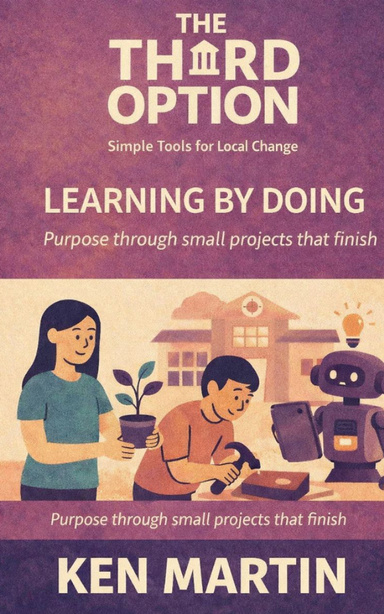
Learning by Doing
A Third Option Education Mini Guide
This ebook may not meet accessibility standards and may not be fully compatible with assistive technologies.
I am a parent of two boys. Most evenings, getting them off their screens to do homework is a negotiation. Sometimes an argument. Often a delay.
What I notice is this. When homework means copying notes or answering questions with no clear end, resistance rises fast. When they are asked to make something concrete, a poster, a short explanation, a set of steps, the friction drops. They start. They finish. That difference matters.
What I notice is not a lack of effort. It is effort without closure. They start tasks. They rarely feel they finish something meaningful.
From their side, learning often feels abstract. The question is not “Did I understand this?” It is “Is this enough?” or “Have I done it the right way?” That uncertainty chips away at confidence.
I am not a teacher, and I do not pretend to know better than the people in classrooms every day. Teachers already juggle pressure, behaviour, targets, and time in ways most parents never fully see. This is not a critique of teachers. It is an observation of the system my boys are growing up inside.
The Learning by Doing mini guide starts with a small, practical shift. Purpose returns when students finish small things that matter.
Not big projects. Not curriculum reform. Small micro-projects that fit inside normal lessons.
- A one-page explainer.
- A diagram that makes sense.
- A fixed error.
- A checklist someone else could follow.
Writing is one option, not the default. What matters is thinking made visible and finished.
Each task has a clear start and a clear end. Each leaves proof. When my boys finish something real, I see the change immediately. They sit differently. They speak differently. Nobody needs to persuade them to engage. The work does that.
I know the concerns teachers and leaders raise. (I have to admit some bias as I come from project based background).
- “This sounds like project-based learning again.”
- “These ideas add workload.”
- “This won’t stand up to inspection or data demands.”
This approach stays deliberately tight. Tasks stay short and bounded. Teachers control scope and timing. Nothing replaces the curriculum. Finished artefacts, fewer incomplete tasks, and faster starts provide evidence alongside formal data.
This complements existing accountability. It does not compete with it.
It also has limits. It assumes basic physical and emotional safety in the classroom. Where that is not present, stabilising behaviour comes first. And it works under pressure.
Details
- Publication Date
- Dec 17, 2025
- Language
- English
- Category
- Education & Language
- Copyright
- All Rights Reserved - Standard Copyright License
- Contributors
- By (author): Ken Martin
Specifications
- Format