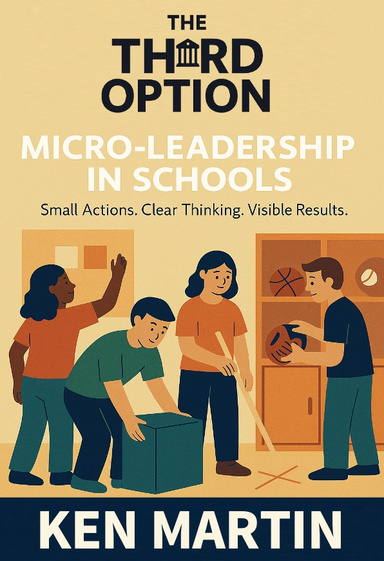
Micro-Leadership in Schools
A Third Option Mini-Guide
This ebook may not meet accessibility standards and may not be fully compatible with assistive technologies.
Why Micro-Leadership Works in Real Classrooms
Big reforms get attention. Small fixes shape daily experience.
Micro-leadership gives students short, safe tasks that remove friction. You get smoother routines and fewer interruptions without heavy systems or extra workload.
Why it works
Students notice issues before adults do. They move around the room more. They feel delays faster. They respond to clutter and tight spaces quicker than teachers, who focus on instruction.
How it works
Micro-leadership breaks improvement into five steps.
• Spot one small issue.
• Fix it safely.
• Check the result.
• Log it.
• Review what changed at the end of the week.
Each step stays short and visible. Students feel progress. Teachers see fewer micro-disruptions.
Roles make it practical
- Spotter finds the issue.
- Fixer handles the change.
- Checker tests the result.
- Reporter captures proof.
This keeps tasks light. No student feels pressure. Each role rotates weekly so everyone takes part.
Proof strengthens the routine
Small fixes show quick gains. Smoother transitions. Better movement. Faster starts. A simple proof sheet tracks the win with a date, issue, small fix, next step, and two photos. After a week, the class sees a visible reduction in friction.
AI supports only safe tasks. AI helps summarise issues students notice, suggests small layout shifts, and tidies logs. It stays away from student tracking or behaviour scoring. The rule stays simple: AI helps organise work, not judge people.
Benefits for each group
- Students: clearer roles, stronger confidence, shorter delays.
- Teachers: less clutter, calmer movement, fewer repeated reminders.
- Leaders: visible routines, low-cost improvement, stronger shared standards.
- Parents: a safer room and smoother days for their children.
Risks and how to manage them
- Risk: over-fixing. Response: One small issue a day only.
- Risk: unsafe changes. Response: The teacher checks each fix before the class uses it.
- Risk: fading interest. Response: short weekly review with a visible log.
The next step. Pick one room. Start with one issue. Rotate roles. Log each fix. Review after five school days. You will see changes quicker than expected because small friction points hold more weight than people notice.
All information on the Third Option - "Simple Tools for Local Change" is on my Substack: https://lnkd.in/e5R4gZJW. Everything is free to use, to share and to adapt at your pleasure. More books and tools are
Details
- Publication Date
- Nov 22, 2025
- Language
- English
- Category
- Education & Language
- Copyright
- All Rights Reserved - Standard Copyright License
- Contributors
- By (author): Ken Martin
Specifications
- Format