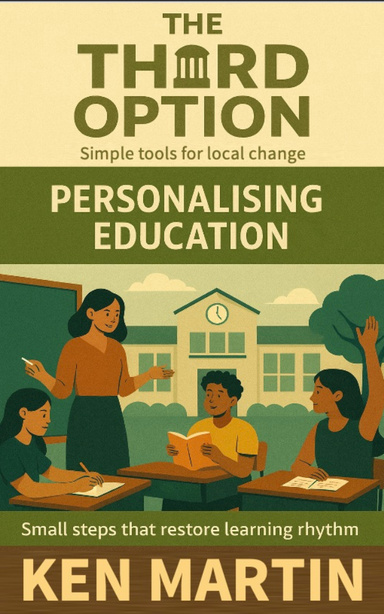
Personalising Education
A Third Option Mini-Guide
This ebook may not meet accessibility standards and may not be fully compatible with assistive technologies.
Most debates about education arrive too late.
They argue about curriculum reform, standards, or technology while classrooms run on survival rhythm. Short lessons. Constant transitions. Heavy marking. Tight pacing. Behaviour escalation. Teachers managing pace instead of shaping learning. Students switching off long before results show it.
Personalisation gets mentioned often. It usually fails. Not because the idea is wrong, but because it arrives as extra work. Another initiative. Another demand layered onto an already overloaded system.
This mini-guide takes a different angle. It treats personalisation as a pressure and rhythm problem, not a curriculum problem. Learning improves when pressure drops. Attention settles when rhythm stabilises. Agency returns through small, bounded choices. Progress shows when thinking becomes visible.
Nothing here requires national reform. It works inside existing constraints. Longer focus blocks where possible. Fewer unnecessary transitions. Clear routines. Simple proof of learning instead of endless output.
AI fits into this picture too. Not as a miracle tool. Not as a threat to teachers. AI exposes fragile assessment habits built around unseen work and recall. Bans are not panic. They are containment. The real task is aligning learning with what survives AI. Explanation. Judgement. Process. Contribution.
This is not reform rhetoric. It is a stability guide for tired systems and tired people.
Small changes. Clear rhythm. Less pressure.
Learning grows when conditions allow it to.
If you want to explore the third option, the entry point is my Substack: https://lnkd.in/e36tmuDx All materials are free to use, share, and adapt.
Details
- Publication Date
- Dec 13, 2025
- Language
- English
- Category
- Education & Language
- Copyright
- All Rights Reserved - Standard Copyright License
- Contributors
- By (author): Ken Martin
Specifications
- Format