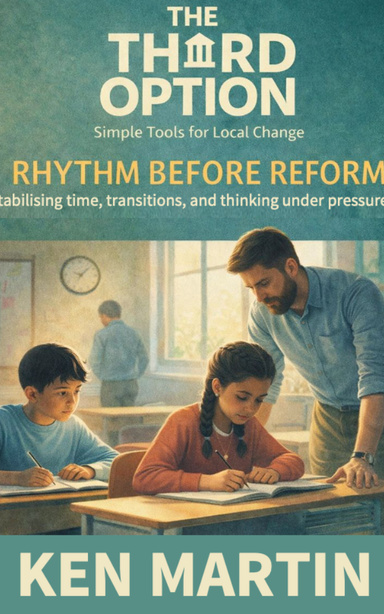
Rhythm Before Reform
A Third Option Education Mini-Guide
This ebook may not meet accessibility standards and may not be fully compatible with assistive technologies.
Why Timetable Switching Belongs to the Past
Timetable switching is a legacy habit. Schools did not choose it. They inherited it from an era built around staffing efficiency, room use, and inspection convenience. It solved logistics. It never solved learning.
Today, the cost is obvious in classrooms. Constant room changes fragment attention. Lessons start late. Endings blur. Teachers spend energy settling classes instead of teaching. Students adapt by waiting for instructions rather than thinking through problems.
This matters more now than ever. AI has shifted what schools need to teach well. Critical thinking. Problem solving. Judgement. These skills do not form in rushed blocks or noisy transitions. They need time to settle, attempt, fail, adjust, and finish. They need calm. They need fewer switches, not more.
Short lessons suit coverage. They do not suit thinking. In calmer, longer learning blocks, something different happens. A problem gets set. Students actually start. They stay with it long enough to struggle productively. The teacher interrupts less because the room settles faster. Work reaches completion. Feedback becomes specific because there is finished work to respond to.
This is not about adding new content or new programmes. It does not increase planning or marking. It removes wasted time spent settling, repeating instructions, and managing constant transitions.
It also does not require curriculum reform, assessment battles, or timetable overhauls. It works inside existing accountability frameworks. Calm starts, predictable routines, and finished work are inspection-friendly conditions, not risks.
This is not well-being theatre. It is capability. Timetable switching persists largely because it always has. Tradition feels safe. But inheritance is not evidence. The timetable solved staffing problems. The problem schools now face is sustained thinking under pressure.
In an AI age, attention is a scarce resource. Schools lose it every time the bell rings. The question is simple. Are your timetables built for movement?
Or for thinking.
USEFUL RESOURCES
1) Education Toolkit Vol.2 https://lnkd.in/ehMPH2sq
2) Education Toolkit Vol.1 https://lnkd.in/eFTZhbxM
If you want to explore the third option, the entry point is my Substack: https://lnkd.in/e36tmuDx. All my materials are free to use.
Details
- Publication Date
- Dec 18, 2025
- Language
- English
- Category
- Education & Language
- Copyright
- All Rights Reserved - Standard Copyright License
- Contributors
- By (author): Ken Martin
Specifications
- Format