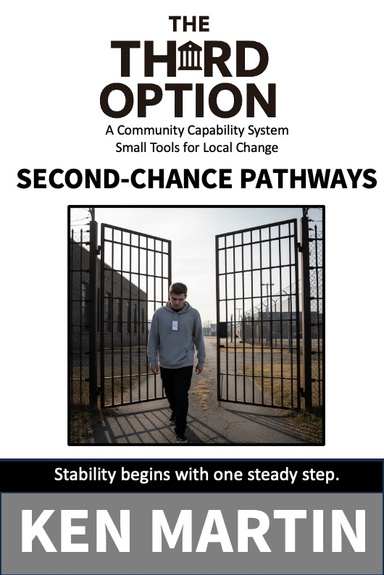
Second-Chance Pathways
A Third Option Mini-Guide
This ebook may not meet accessibility standards and may not be fully compatible with assistive technologies.
Second Chance Pathways
We talk a lot about crime and punishment, but we skip the part that decides what happens next. Most people leaving prison face the same problem. Their days have no shape. Their pressure stays high. Every choice feels loaded. One bad hour sets off a chain.
A significant share of people leaving custody face this early instability. Even small gaps in routine raise the risk of missed appointments or pressure-driven behaviour.
This mini guide focuses on the first steps that make a return to steady life possible.
When a person steps out with no structure, the emotional load spikes. Decisions feel heavier, and simple actions feel risky. Early shape brings relief.
In the first 48 hours, you keep things simple. One anchor person. One wake time. One meal window. No big decisions. Pressure drops and people breathe again.
Next comes micro-capability. One task a day at the same hour. Light expectations. Proof logs. You remove tasks that overwhelm. Success becomes visible and the person sees movement again. A ten-minute task at the same hour each day often becomes the first visible proof that stability is possible.
System coordination matters. Probation gets short updates. Housing teams get clear signals. Employers get one small role they know is safe. Everyone works from the same picture. Without this alignment, rhythm breaks early and pressure climbs fast. Support workers spend more time firefighting and less time guiding.
Identity repair grows from repeated wins. When rhythm holds, people stop seeing themselves through old labels. Communities respond to present behaviour. Employers trust what they see. Families feel more secure. This moment often shifts how a person sees themselves. Rhythm becomes identity.
Contribution is the turning point. Small roles build capability. Paired routines keep confidence steady. Micro-apprenticeships open the door to something larger. For employers, predictable attendance reduces uncertainty and shows when a longer role makes sense.
Long-term rhythm keeps everything in place. Weekly review. Predictable routines linked to capability. Support for substance triggers. Daily movement. None of this is theory. These are the small steps that give people a real shot at stability. When pressure drops, contribution rises. And contribution is what communities trust.
This pathway also falls within the broader Third Option framework. Contribution starts small, grows through rhythm.
Details
- Publication Date
- Dec 10, 2025
- Language
- English
- Category
- Social Science
- Copyright
- All Rights Reserved - Standard Copyright License
- Contributors
- By (author): Ken Martin
Specifications
- Format