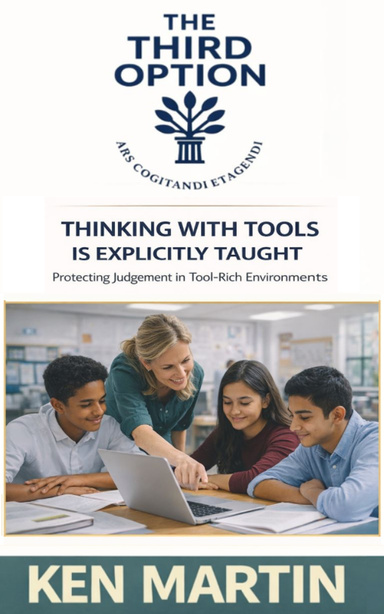
Thinking With Tools is Explicitly Taught
A Third Option Education Pillar Guide
This ebook may not meet accessibility standards and may not be fully compatible with assistive technologies.
We keep seeing schools swing between two extremes on AI. On one side, outright bans. Posters on walls. Threats of consequences. Control used to signal rigour.
On the other, a rush to teach prompts, tools, shortcuts. Entire lessons built around “how to use AI well,” as if fluency equals understanding.
Both reactions come from the same place. Panic.
And that panic is understandable. Inspection pressure, results cycles, parental scrutiny, and trust directives compress decision space. Leaders are expected to act quickly and visibly, even when the ground is shifting.
AI did not create a new problem in schools. It exposed an old one. For years, we relied on outputs as a proxy for thinking. When tools started producing polished work at speed, the cracks became obvious. Many years ago, I remember doing Maths where the visible working out gained more marks than the actual answer.
The real issue is not AI. It’s that thinking was rarely visible in the first place.
When reasoning stays hidden, assessment loses its anchor. Teachers start guessing. Students start managing risk. Trust thins. Systems respond with more rules, more checks, more enforcement. Not because people are failing, but because the design is.
That’s what the Thinking With Tools Is Explicitly Taught pillar is about.
It isn’t a programme. It isn’t a rollout. It doesn’t tell schools which tools to use or how fast to move. It does not ask leaders to gamble reputation or results on untested change. It names a condition.
A school either teaches students how to question outputs, compare them with their own reasoning, spot gaps and assumptions, and decide when a tool helped or interfered with thinking. Or it doesn’t.
When that condition holds, judgement survives speed. Tool use becomes visible, discussable, and bounded. Assessment regains signal. Conflict drops because ambiguity drops.
When it doesn’t, schools get stuck in the same loop. Ban or tolerate. Control or hope. Neither protects thinking. And doing nothing is not neutral. Leaving judgement implicit while tools accelerate is the highest-risk option of all.
AI didn’t break the system. It simply removed the illusion that outputs were ever enough.
This pillar exists to protect the space where judgement can still operate. Not by slowing technology, but by making thinking explicit while it accelerates. Not by reforming schools, but by holding a condition steady under pressure.
Stability doesn’t come from novelty. It comes from conditions that h
Details
- Publication Date
- Dec 23, 2025
- Language
- English
- Category
- Education & Language
- Copyright
- All Rights Reserved - Standard Copyright License
- Contributors
- By (author): Ken Martin
Specifications
- Format