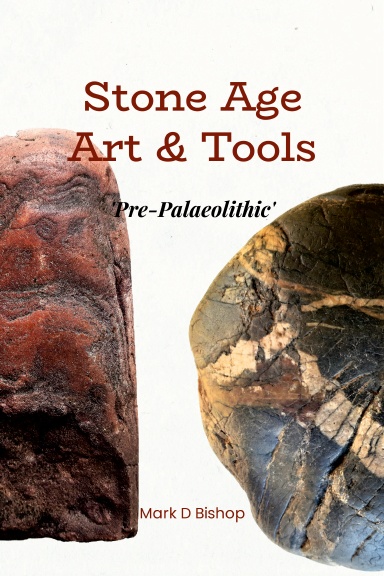
One important factor in the overall equation of archaeology (one that has evaded scientific research for far too long) concerns the art that archaic hominins produced. Because wood, antler, ivory and leather are so subject to decay, very few artworks made from these materials survive. Nonetheless, stone does remain relatively unchanged for millions of years; and we have hundreds of thousands of worked Stone Age implements as proof of these industries. What is generally under discussion however is whether some early examples were actually created by the forces of nature, whether some natural artefacts were used as tools, or whether some that look to be natural were made by humans. All are missing the axiomatic point though.
So, the foremost question that needs to asked here is, “What about the art expressed on these Stone Age tools, the art which science has sought to neglect?” It is an enquiry on which most researchers in the field of Stone Age implements tend to draw a blank, despite unequivocal contextual references. This work seeks to resolve these issues by showing that art is very much evident on stone tools and that these implements are often works of art in themselves; many being made-to-order, personalised treasures. When viewed artistically then, little has really changed in this world of artistic tool making, for whose recent ancestors did not cherish the tools of their trade and who nowadays does not care for one’s own work equipment? So, why should not creative archaic hominins have felt and responded the same as us?
It is hoped that this work will go some way in furthering the recognition of portable rock art by helping to open the unbiased reasoning processes that are so often lacking in scientific endeavour; a missing link that is mainly due to unwillingness and the non-recognition of the artistic temperament of Stone Age tool makers and artists alike. By being able to recognise portable rock art when found in the field, by being able to appreciate it, then by accepting it as a record and expression of people’s lives and beliefs, a much more complex, down-to-earth and detailed understanding of archaic hominins will become apparent; as opposed, that is, to trying to understand these societies and their customs through narrow misinterpretations of their artefacts being mere tools and crude weapons of equally mislabelled ‘nomadic hunter gathers’. Perhaps archaic hominins were actually of the same artistic calibre as us Homo Sapiens.
Details
- Publication Date
- Jun 14, 2026
- Language
- English
- ISBN
- 9781291651805
- Category
- History
- Copyright
- All Rights Reserved - Standard Copyright License
- Contributors
- By (author): Mark D Bishop
Specifications
- Pages
- 269
- Binding Type
- Paperback Perfect Bound
- Interior Color
- Color
- Dimensions
- Royal (6.14 x 9.21 in / 156 x 234 mm)
Keywords
archaeologyprehistoryancient humansarchaic homininsHomo ErectusHomo HeidelbergensisNeanderthalshomo HabilisSouthern Englandhandaxesprehistoric toolspestlesancient artMother Goddessfertility symbolshead stonesmasksAnglian MISIce AgeMarine Isotope StagesHoxnianCromarianfield researchAxe ValleyartefactsartifactsartyfactsStone Ageportable rock artflintchertknappingblack limestonecarvinggrindingmilling stonescognitive abilitybrutalist artart nuveauimpressionist artmodern artochre colouringapplied ochremanganese staininggraniteprehistoric societyartisansartistscreativityweapons