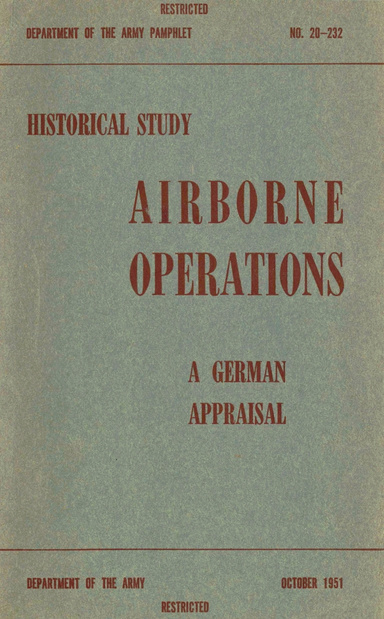
Airborne Operations: A German Appraisal. German Report Series Historical Study
Dept. of the Army Pamphlet No. 20-232, October 1951
This ebook may not meet accessibility standards and may not be fully compatible with assistive technologies.
This pamphlet was written for the Historical Division, EUCOM, by a committee of former German officers.
It comprises a review of German airborne experience in World War II, an appraisal of German successes and failures, the reasons for the apparent abandonment of large-scale German airborne operations after the Crete operation, the German experience in opposing Allied and Russian airborne operations, an appraisal of the effectiveness of these operations, and the probable future of airborne operations.
It was believed that the contributors to this study represented a valid cross-section of expert German opinion on airborne operations. Since the contributors include Luftwaffe and Army officers at various levels of command, some divergences of opinion were inevitable; these were listed and, wherever possible, evaluated by the principal German author. However, the opinions of Generalfeldmarschall Albert Kesselring are given separately and without comment wherever they occur in the course of the presentation.
This study is concerned only with the landing of airborne fighting forces in an area occupied or controlled by an enemy and with the subsequent tactical commitment of those forces in conventional ground combat.
Contents
(Chapter 1) German Airborne Operations in World War II
(I) Principles of Employment
(II) Airborne Tactics
(III) Parachute Troops
(IV) Air-Transported Troops
(V) Troop-Carrier Units
(VI) Reasons for Success and Failure
(VII) German Air Landings after Crete
(Chapter 2) Allied Airborne Operations in World War II
(I) Passive Defense Measures
(II) The German Warning System
(III) Counterattack in the Air
(IV) Antiaircraft Defense Fire
(V) Counterattack on the Ground
(VI) Counterlanding into the Enemy Airhead
(VII) An Appraisal of Allied Air Landings
(VIII) Reflections on the Absence of Russian Air Landings
(Chapter 3) Conclusions
(I) Evaluation of Past Airborne Experience
(II) Limitations of Airborne Operations
(III) Advantages of Airborne Operations
(IV) Requirements for Success
(V) Antiairborne Defense
(VI) Future Possibilities
(Appendix) Notes on German Airborne Operations
(I) Equipment of German Parachute Troops
(II) German Employment of Troop-Carrier Units
(III) Technique and Tactics of Airborne Operations
Details
- Publication Date
- Oct 27, 2021
- Language
- English
- Category
- History
- Copyright
- All Rights Reserved - Standard Copyright License
- Contributors
- By (author): Merriam Press
Specifications
- Format
Keywords
Merriam PressRay MerriamGerman airborne forcesFallschirmjaegerFallschirmjagerLuftwaffeGeneralfeldmarschall Albert KesselringAirborne TacticsParachute TroopsTroop-Carrier UnitsCrete airborne operationAllied Airborne OperationsGerman Warning SystemAntiaircraft Defense FireCounterlanding into the Enemy AirheadAllied Air LandingsRussian Air LandingsLimitations of Airborne OperationsAdvantages of Airborne OperationsAntiairborne DefenseEquipment of German Parachute TroopsGerman Employment of Troop-Carrier UnitsTechnique and Tactics of Airborne OperationsWWII airborne operationsWWII paratroopers