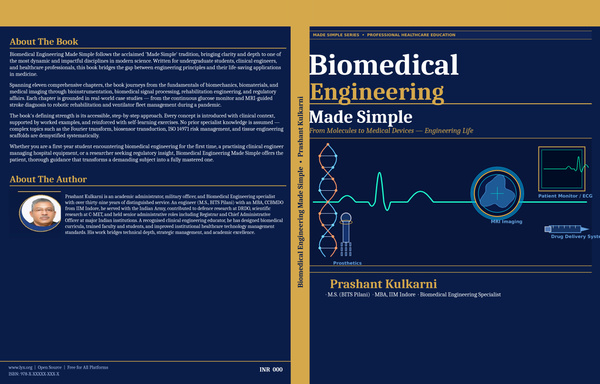
Biomedical Engineering Made Simple
This ebook may not meet accessibility standards and may not be fully compatible with assistive technologies.
Full Title: Biomedical Engineering Made Simple
Author Name: Prashant Kulkarni
Publication Date: June 15, 2026
Language: English
Copyright Holder: Prashant Kulkarni
Biomedical engineering is not a textbook discipline. It does not live in equations alone, nor in circuit diagrams, nor in the sterile pages of a regulatory document. Biomedical engineering lives in the intensive care unit at 2:00 AM, when a ventilator alarm sounds and a clinical engineer is the only person in the hospital who knows why. It lives in the operating theatre, when a surgeon places a stent the size of a grain of rice into a blocked artery. It lives in the quiet moment when a child with a cochlear implant hears her mother’s voice for the first time. If you are a student sitting in the back of a lecture hall wondering, “When will I ever use this in a real hospital?” or an engineer who has just realized that a misplaced semicolon in code could be fatal, this book was written for you. Most biomedical engineering textbooks fall into one of two traps: they are either too theoretical (full of mathematics but empty of clinical context) or too superficial (a catalogue of devices with no explanation of how they work). Biomedical Engineering Made Simple walks the middle path. It explains the "why" just as much as the "how." It begins with the patient’s problem and ends with the engineer’s solution. And it never forgets that behind every medical device is a human being waiting for help. What makes this biomedical engineering textbook fundamentally different? Almost every major concept is illustrated with five detailed, real-world examples. This "Power of Five" structure ensures that students learn by seeing the same principle applied in multiple, concrete contexts. Whether discussing biomaterials, medical imaging, or cybersecurity, the pattern is consistent: a clear, rigorous explanation, followed by five distinct examples showing how the theory translates into practice. You won't just read about the Nernst equation; you will see it applied across five different cellular and clinical scenarios.
Details
- Publication Date
- Jul 18, 2026
- Language
- English
- Category
- Engineering
- Copyright
- All Rights Reserved - Standard Copyright License
- Contributors
- By (author): Prashant Kulkarni
Specifications
- Format
Keywords
Biomedical engineering textbookClinical engineering fundamentalsMedical device design and developmentBioengineering principlesIntroduction to biomedical engineeringBiomedical engineering for undergraduatesBiomedical equipment maintenancePatient-centric medical engineeringOperational amplifiers in medicineInstrumentation amplifier designCommon-mode rejection ratio (CMRR)Medical isolation amplifiersElectrical safety in medical devicesBiopotential electrode interfaceActive and passive transducersAnalog to digital conversion (ADC) medicalMicrocontrollers for medical devicesNoise and artifact removalBioelectric potentialsResting membrane potential Nernst equationElectrocardiogram (ECG) measurementElectroencephalogram (EEG) instrumentationElectromyogram (EMG) sensorsSource signals and measurement chainsSignal conditioning for biosignalsBiopotential amplifier noiseBiomedical sensors and transducersPhotoplethysmography (PPG)Pulse oximetry principlesContinuous Glucose Monitor (CGM) engineeringWearable medical devicesImplantable biosensorsTemperature and pressure sensors (Thermistors RTDs, MEMS)Internet of Medical Things (IoMT) securitySmart medical devicesBiomedical signal processingFourier transform in medicineWavelet transforms for ECG/EEGIndependent Component Analysis (ICA) for artifactsFeature extraction biomedical dataMachine learning in medical devicesDeep learning for diagnosticsExplainable AI (XAI) in healthcareAtrial fibrillation detection algorithmsSystem identification and modelingMedical imaging physicsX-ray tube engineeringComputed Tomography (CT) reconstruction algorithmsMagnetic Resonance Imaging (MRI) pulse sequencesUltrasound transducer physics