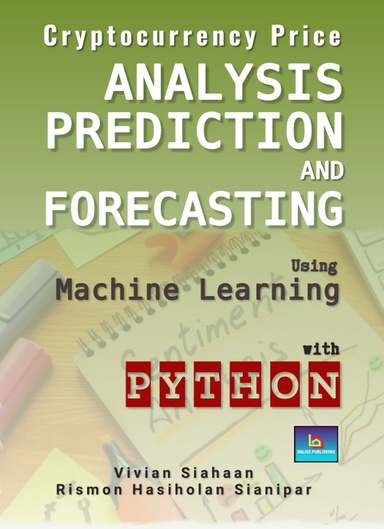
CRYPTOCURRENCY PRICE ANALYSIS, PREDICTION, AND FORECASTING USING MACHINE LEARNING WITH PYTHON
ByVivian SiahaanRismon Hasiholan Sianipar
This ebook may not meet accessibility standards and may not be fully compatible with assistive technologies.
A cryptocurrency is a tradable digital asset or digital form of money, built on blockchain technology that only exists online. Cryptocurrencies use encryption to authenticate and protect transactions, hence their name. There are currently over a thousand different cryptocurrencies in the world. Over the last few years, cryptocurrency prices have risen and then fallen. Crypto marketplaces do not guarantee that an investor is completing a purchase or trade at the optimal price. As a result, many investors take advantage of this by using arbitrage to find the difference in price across several markets. The first decentralized cryptocurrency was Bitcoin, which first released as open-source software in 2009. As of March 2022 there were more than 9,000 other cryptocurrencies in the marketplace, of which more than 70 had a market capitalization exceeding $1 billion.
The dataset used in this project has 942297 rows and 13 columns. Following are the columns in the dataset: slug, symbol, name, date, ranknow, open, high, low, close, volume, market, close_ratio, and spread.
To perform forecasting based on regression on close price of Bitcoin, you will use: Linear Regression, Random Forest regression, Decision Tree regression, Support Vector Machine regression, Naïve Bayes regression, K-Nearest Neighbor regression, Adaboost regression, Gradient Boosting regression, Extreme Gradient Boosting regression, Light Gradient Boosting regression, Catboost regression, and MLP regression.
The machine learning models used predict gold daily returns as target variable are K-Nearest Neighbor classifier, Random Forest classifier, Naive Bayes classifier, Logistic Regression classifier, Decision Tree classifier, Support Vector Machine classifier, LGBM classifier, Gradient Boosting classifier, XGB classifier, MLP classifier, and Extra Trees classifier. Finally, you will plot boundary decision, distribution of features, feature importance, predicted values versus true values, confusion matrix, learning curve, performance of the model, and scalability of the model.
Details
- Publication Date
- Mar 29, 2023
- Language
- English
- Category
- Computers & Technology
- Copyright
- All Rights Reserved - Standard Copyright License
- Contributors
- By (author): Vivian Siahaan, By (author): Rismon Hasiholan Sianipar
Specifications
- Format