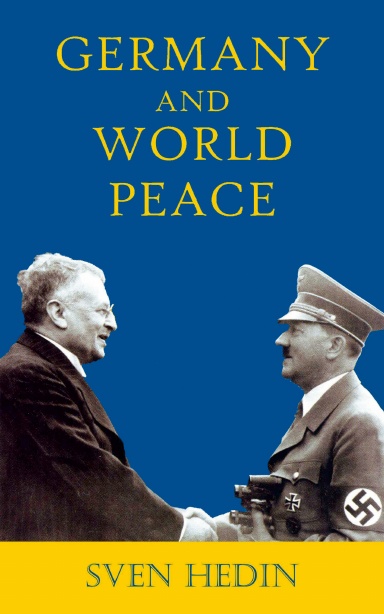
Sven Hedin’s Germany and World Peace (1937) offers a controversial defense of Germany’s resurgence under National Socialism in the years following World War I. He portrays Germany as a misunderstood power striving for peace and stability, while casting the Treaty of Versailles as a source of ongoing injustice that provoked national renewal and rearmament.
Hedin argues that Western powers—particularly Britain and France—failed to create a fair or enduring peace, and he frames Germany’s ambitions as reactive rather than aggressive. Though he expresses admiration for the order and revitalization he observed under National Socialist governance, he also includes criticisms of its more extreme measures. His refusal to censor these critiques at the behest of German authorities led him to withhold publication of the book in Germany, revealing tensions between his support for the regime’s goals and his discomfort with its authoritarian excesses.
The book is best read as a reflection of its time—an attempt to make sense of interwar geopolitics through the lens of a pro-German observer deeply committed to European stability, though arguably blind to the broader consequences of National Socialist ideology.
Details
- Publication Date
- Jun 22, 2025
- Language
- English
- Category
- History
- Copyright
- Creative Commons NonCommercial, NoDerivatives (CC BY-NC-ND)
- Contributors
- By (author): Sven Hedin
Specifications
- Pages
- 354
- Binding Type
- Paperback Perfect Bound
- Interior Color
- Black & White
- Dimensions
- Novella (5 x 8 in / 127 x 203 mm)