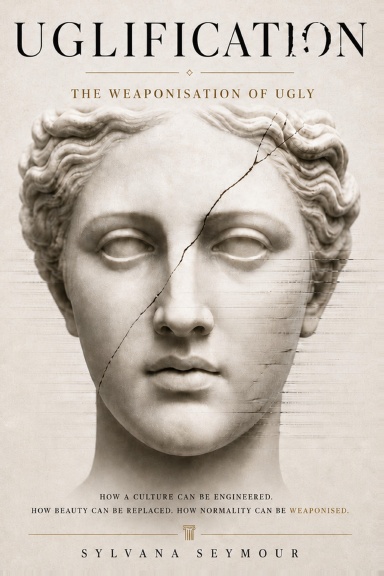
What if nothing collapsed... and everything simply shifted?
Not suddenly. Not dramatically.
But gradually. Quietly. Repeatedly.
A small change.
Introduced.
Seen again.
Accepted.
Then seen again.
Over time, what once stood out begins to blend in.
What blends in becomes familiar.
What is familiar becomes expected.
And eventually, the baseline moves.
Most people assume that standards decline through obvious disruption. That something breaks. That something fails.
But that is not how it happens.
Change does not need to be loud to be permanent. It does not need to be forced to be effective.
It can be introduced in increments so small they pass without notice. It can be repeated until resistance fades. It can be absorbed until it feels natural.
This is not a theory of taste.
It is a study of process.
Inside Uglification, you will begin to see:
How environments shape what you recognise as normal
How repeated exposure alters perception without conscious awareness
How standards can be lowered without resistance
How deviation becomes acceptable, and acceptable becomes expected
How the baseline shifts, quietly, and then holds
These patterns are not isolated.
They appear across culture, media and everyday life. They operate through repetition, not force. Through familiarity, not persuasion.
And because of that, they are rarely questioned.
The result is not immediate.
It accumulates.
Small changes, repeated often, produce outcomes that feel permanent. What once would have been rejected is no longer noticed. What is no longer noticed becomes part of the environment.
And what is part of the environment begins to define the standard.
This is what Uglification examines.
Not what people prefer.
But how preference is shaped.
Not what changed.
But how change was introduced.
Not why something feels normal.
But how it came to feel that way.
Once you see the process, it becomes difficult to ignore.
You begin to recognise the pattern.
The repetition.
The shift.
And the moment where something changed...
without appearing to change at all.
The baseline does not hold itself.
It moves.
This book shows you how.
Details
- Publication Date
- Jun 8, 2026
- Language
- English
- ISBN
- 9781764198035
- Category
- Social Science
- Copyright
- All Rights Reserved - Standard Copyright License
- Contributors
- By (author): Sylvana Seymour
Specifications
- Pages
- 197
- Binding Type
- Paperback Perfect Bound
- Interior Color
- Black & White
- Dimensions
- US Trade (6 x 9 in / 152 x 229 mm)
Keywords
uglificationurban stressbuilt environmenturban uglinesseffects of architecturepsychology of architecturehostile architectureugly buildingsarchitectural criticismbuilt environment psychologyurban planningmodern architectureenvironmental psychologyarchitecture and mental healthhuman centred designpublic space designurban aestheticscognitive overloadsensory overloadvisual pollutionenvironmental stresswalkable citieswalkable communitiesurban sociologyarchitectural theorycity environmentsurban declineliveable citiesneighbourhood designcommunity wellbeingsocial isolation