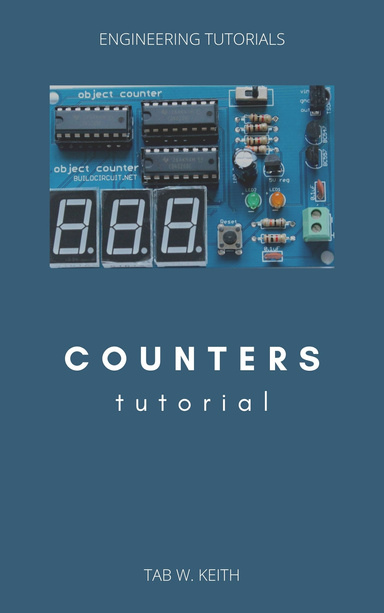
Counters tutorial
ByTran A
This ebook may not meet accessibility standards and may not be fully compatible with assistive technologies.
Counters tutorial
Like shift registers and other combinational circuits, there is another important element in digital electronics which we use most. They are counters. Counters are used not only for counting but also for measuring frequency and time ; increment memory addresses .
Counters are specially designed synchronous sequential circuits, in which , the state of the counter is equal to the count held in the circuit by the flip flops. Counters calculate or note down the number that how many times an event occurred.
Counters are the crucial hard ware components, and are defined as “The digital circuit which is used to count the number of pulses”. Counters are well known to us as “Timers”. Counter circuits are the best example for the flip flop applications. Counters are designed by grouping of flip flops and applying a single clock signal to them. In simple words, the counters are those, which have the group of storage elements like flip flops to hold the count.
Counters have modes. The ‘mod’ of the counter represents the number of states of the cycles through it, before setting the counter to its initial state. For example, a binary mod 8 counter has 8 countable states. They are from 000 to 111. So the mod 8 counter counts from 0 to 7.
A binary mod 4 counter has 4 count states, from 000 to 011. So the mod 4 counter counts from 0 to 4. This means, in general a mod N counter can contain n number of flip flops, where 2n = N.
Details
- Publication Date
- Oct 14, 2023
- Language
- English
- Category
- Engineering
- Copyright
- All Rights Reserved - Standard Copyright License
- Contributors
- By (author): Tran A
Specifications
- Format
- EPUB