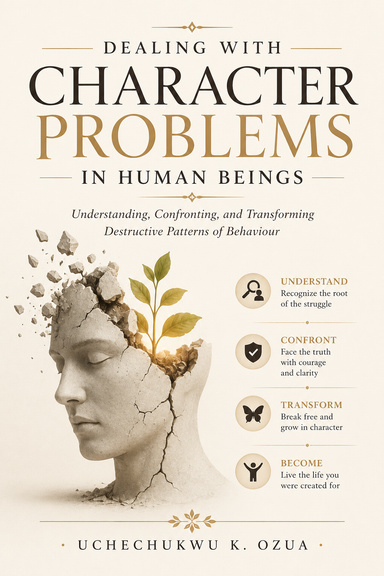
Dealing with Character Problems in Human Beings
Understanding, Confronting, and Transforming Destructive Patterns of Behaviour
This ebook meets accessibility standards and is compatible with assistive technologies. Accessibility compliance is determined by the publisher and creator.
Every human being has weaknesses. Some weaknesses are visible. Others are hidden beneath a smile, a religious appearance, professional success, social influence, or an impressive public reputation. A person may appear successful on the outside while carrying destructive patterns of behaviour within.
Many people spend their lives trying to change their circumstances while refusing to examine their character. They change jobs, relationships, churches, cities, schools, and environments, yet continue to carry the same destructive behaviours wherever they go. A man may leave one marriage convinced that his wife was the entire problem, only to bring the same impatience, the same suspicion, and the same unwillingness to listen into the next relationship. A worker may move from company to company, certain that every employer has been unreasonable, never once suspecting that the common factor in every conflict has been himself.
The problem is often not the environment. Sometimes the problem is the person.
A person may blame everybody else for his or her failures but never examine personal attitudes. A husband may blame his wife for every problem in the marriage. A wife may blame her husband for every disagreement. A worker may blame the employer for every failure. A student may blame the teacher for poor performance. A leader may blame followers for every mistake. A parent may blame society for the behaviour of the children.
Yet, in many situations, the person may be carrying a character problem that has never been confronted.
This is one of the most difficult truths about human life: people often see the faults of others more clearly than they see their own faults. Scripture addressed this long before modern psychology gave it a name. Jesus asked, "Why beholdest thou the mote that is in thy brother's eye, but considerest not the beam that is in thine own eye?" (Matthew 7:3). The question is not rhetorical decoration; it is a diagnosis of the human condition. It is easier to identify the pride of another person than to recognize pride in oneself. It is easier to call another person stubborn than to admit one's own stubbornness. It is easier to accuse someone of anger while defending one's own temper. It is easier to criticize dishonesty in others while making excuses for personal deception.
Character problems are dangerous because they can become normal to the person who possesses them. A liar may eventually stop seeing lying as a serious problem. An angry person m
Details
- Publication Date
- Jul 24, 2026
- Language
- English
- ISBN
- 9781105024702
- Category
- Religion & Spirituality
- Copyright
- All Rights Reserved - Standard Copyright License
- Contributors
- By (author): Uchechukwu K. Ozua
Specifications
- Format
- EPUB