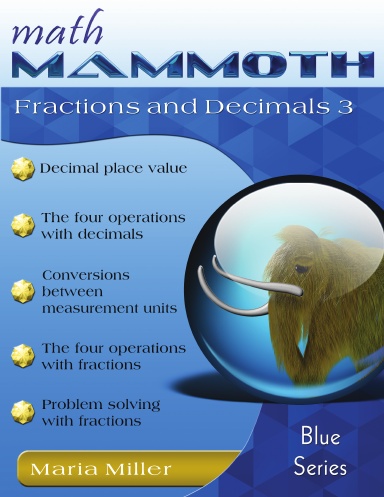
Math Mammoth Fractions and Decimals 3
Blue Series
Usually printed in 3 - 5 business days
Math Mammoth Fractions and Decimals 3 continues the study of fraction and decimal topics on the 6th grade level. This book assumes the student already has studied fractions and decimals in the past. The goal of the book is to go through all of the fraction and decimal arithmetic using up to six decimal digits and larger denominators in fractions than in 4th and 5th grade materials.
First we study all four operations of decimals, the metric system, and using decimals with measuring units. We start out by studying place value with decimals and comparing decimals up to six decimal digits. The next several lessons contain a lot of review, just using longer decimals than in fifth grade: adding and subtracting decimals, rounding decimals, multiplying and dividing decimals, fractions and decimals, and multiplying and dividing decimals by the powers of ten.
In the lessons about multiplication and division of decimals, students work both with mental math and with standard algorithms. The lessons that focus on mental math point out various patterns and shortcuts for students, helping them to see the structure and logic in math. I have also explained why the common rules (or shortcuts) for decimal multiplication and decimal division actually work, essentially providing a mathematical proof on a level that sixth graders can hopefully understand.
After decimals, the book covers all fraction arithmetic. We begin with a review of fraction arithmetic from fifth grade—specifically, addition, subtraction, simplification, and multiplication of fractions. Then the lessons focus on division of fractions.
The introductory lesson on the division of fractions presents the concept of reciprocal numbers and ties the reciprocity relationship to the idea that division is the appropriate operation to solve questions of the form, “How many times does this number fit into that number?” Students learn to solve questions like that through using visual models and writing division sentences that match them. Naturally, the lessons also present the shortcut for fraction division—the so-called “invert (flip)-and-multiply” rule.
In two lessons that follow, students apply what they have learned to solve problems involving fractions or fractional parts. A lot of the problems in these lessons are review in the sense that they involve previously learned concepts and are similar to problems students have solved earlier, but many involve the division of fractions.
Details
- Publication Date
- Apr 26, 2010
- Language
- English
- Category
- Education & Language
- Copyright
- All Rights Reserved - Standard Copyright License
- Contributors
- By (author): Maria Miller
Specifications
- Pages
- 107
- Binding Type
- Paperback Perfect Bound
- Interior Color
- Color
- Dimensions
- US Letter (8.5 x 11 in / 216 x 279 mm)