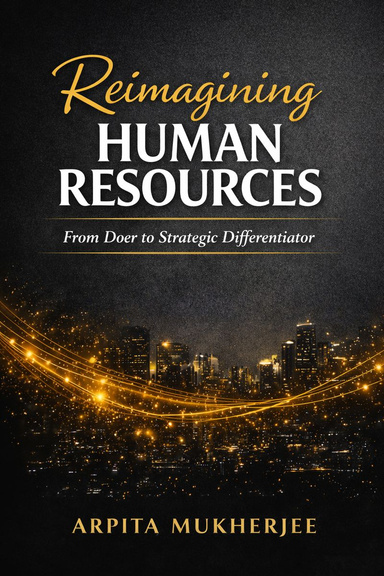
Reimagining Human Resource: From Doer to Differentiator
Why HR Must Move from Execution to Architecture
This ebook may not meet accessibility standards and may not be fully compatible with assistive technologies.
In today’s increasingly complex and competitive business environment, Human Resources occupies a central position within organisations—yet often without real authority, influence, or strategic ownership. Despite being closely connected to talent, culture, and capability, HR in many organisations continues to function primarily as an executor of decisions rather than a driver of strategy.
**Reimagining Human Resources: From Doer to Strategic Differentiator** confronts this contradiction head-on.
The book examines why HR, despite decades of expansion in scope and responsibility, continues to struggle to move beyond operational execution. Tracing the evolution of HR from personnel administration to recruitment, onboarding, performance management, and engagement, it highlights how the function has grown wider—but not stronger—remaining reactive and dependent on direction from other departments.
Rather than criticising HR’s limitations, the book focuses on the systemic conditions that have shaped HR into a coordinating function rather than a decision-owning one. It explores how recruitment, onboarding, and performance management lose strategic value when HR is positioned as a facilitator instead of an architect. Misalignment between organisational intent, hiring decisions, and employee expectations is examined as a key driver of early attrition and disengagement.
A central theme of the book is the reframing of onboarding as a foundational human experience rather than an administrative process, and performance failure as a diagnostic signal of organisational design gaps rather than individual inadequacy.
The book establishes **Total Rewards** as HR’s first true strategic domain—where compensation, benefits, incentives, career progression, and equity must be governed as an integrated system rather than managed as isolated components. It further addresses advanced themes such as workforce planning models, career pathing, interest alignment, performance enablement, and organisation-wide accountability structures.
At its core, the book argues that HR’s true power lies not in visibility or advocacy, but in architecture—the deliberate design of people systems that sustain organisations through growth.
Details
- Publication Date
- Dec 23, 2025
- Language
- English
- Category
- Business & Economics
- Copyright
- All Rights Reserved - Standard Copyright License
- Contributors
- By (author): Arpita Mukherjee
Specifications
- Format