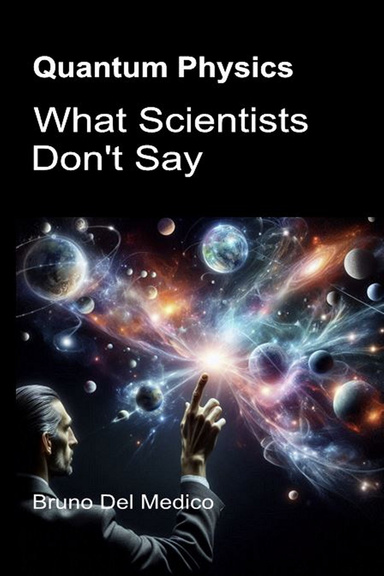
Quantum Physics. What Scientists Don't Say
The implications of a theory that generates incredible perspectives, capable of changing the worldview.
This ebook may not meet accessibility standards and may not be fully compatible with assistive technologies.
We live in extraordinary times. Never before have the boundaries separating science from philosophy been so thin, almost imperceptible, paving the way for new currents of thought that seek to reconcile the languages of numbers and intuition, experiment and contemplation. Among these, one of the most fascinating is undoubtedly quantum metaphysics: a current of thought that evokes profound suggestions, leading us to wonder not only how our universe really works, but also what it means to "be."
The expression "quantum physics" reminds us of the scientific achievements of the twentieth century-from Einstein, who opposed, the indeterminism of this theory with his famous dictum "God does not play dice," to Schrödinger with his enigmatic cat, simultaneously both alive-and-dead.
Instead, metaphysics harks back to a much older tradition rooted in Aristotelian philosophy. Metaphysics deals with what lies "beyond" (meta) the physical world, investigating the ultimate nature of reality, the fundamental principles of being and the deep reasons behind existence itself.
Today, in a context in which quantum phenomena seem to constantly challenge rationality and intuition, this dialogue between physics and philosophy has generated a new form of reflection, which many call precisely "quantum metaphysics."
To understand the revolutionary scope of quantum metaphysics, we must start with a central idea of quantum physics itself. The laws that govern the subatomic world not only contradict our classical view of reality but also challenge common sense. In the quantum world, a particle can be in multiple states at once (the famous superposition principle) until it is observed. Reality, then, seems to "be" only if we observe it. But what does this mean in metaphysical terms? Is there really a reality independent of the observing subject, or does the universe need consciousness to manifest itself?
The question is not a new one: already Immanuel Kant, in the 18th century, argued that we cannot know the world "in itself" but only as it appears to us, through the categories of our thinking.
An emblematic example linking science and philosophy is the two-slit experiment, one of the pillars of quantum physics. In its simplest scheme, a single particle-such as an electron-is fired toward a barrier with two slits. If we do not observe it, amazingly that single electron passes through both slits, so it behaves like a wave. In contrast, if we observe it, the electron passes through only
Details
- Publication Date
- Apr 4, 2025
- Language
- English
- Category
- Science & Medicine
- Copyright
- All Rights Reserved - Standard Copyright License
- Contributors
- By (author): Bruno Del Medico
Specifications
- Format
- EPUB