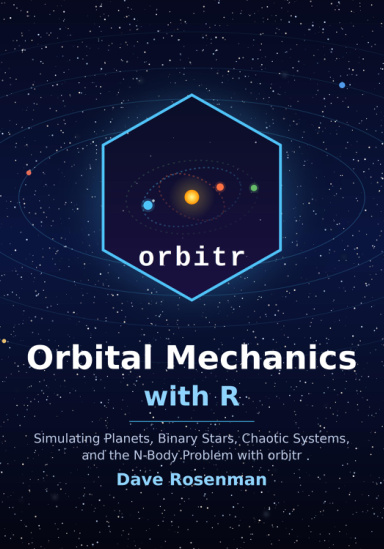
Orbital Mechanics with R
Simulating Planets, Binary Stars, Chaotic Systems, and the N-Body Problem with orbitr
Usually printed in 3 - 5 business days
Orbital Mechanics with R is a physics book that uses simulation the way a lab course uses a bench. Built on orbitr, an R package for simulating gravity, it derives every result on paper and then checks it against a simulation you can run yourself: why the Velocity Verlet integrator keeps a planet on a closed ellipse when the textbook Euler method spirals it away, where the circular-orbit speed comes from and how it leads to Kepler's three laws, what gravitational softening does to the force law, and what makes three bodies chaotic when two are not.
The second half turns the physics loose on real astronomy: Kepler's third law verified across the solar system, the circumbinary planet Kepler-16b built from conservation of momentum, Mars going retrograde from Earth's point of view, a chaotic triple star forgetting its initial conditions, a comet's perihelion passage, and the conservation laws read to decide whether a simulation can be trusted. A final part looks under the hood at the C++ engine and at what a point-mass Newtonian model leaves out.
For R users who want the physics and for physics and astronomy students who want to compute. Calculus and vectors are assumed; R is not — one appendix takes you from nothing to running the book's code, and another collects the mathematics the derivations use. Every figure was produced by the code printed beside it. The full text is free to read online at book.orbit-r.com; this print edition is sold at cost.
Details
- Publication Date
- Oct 2, 2026
- Language
- English
- ISBN
- 9780557801305
- Category
- Science & Medicine
- Copyright
- All Rights Reserved - Standard Copyright License
- Contributors
- By (author): Dave Rosenman
Specifications
- Pages
- 210
- Binding Type
- Paperback Perfect Bound
- Interior Color
- Color
- Dimensions
- Executive (7 x 10 in / 178 x 254 mm)